Lesson 1: Two palettes, one small landscape
Unit overview · Next: Lesson 2
About 60-65 minutes. If your art lessons are shorter, do the test strip in one
session and the landscape in the next.
Goal
Students test two palettes (red-yellow-blue and cyan-magenta-yellow) side by
side, decide which mixes the greens and purples they want, and use their chosen
palette to paint a finished postcard-sized landscape.
Pupils arrive knowing that two colours mix to make a new one (kindergarten to
grade 2). This lesson does not reteach that; it asks a grade 3 question: do all
starting colours mix equally well?
Materials (per group)
- Red-yellow-blue set: a warm red (for example vermilion), yellow, a mid blue
(for example ultramarine).
- Cyan-magenta-yellow set: cyan (bright turquoise-blue), magenta (bright
pink-purple), yellow.
- White. Label every pot with its name in words.
- One palette per pupil with a line drawn across the middle ("RYB" on one side,
"CMY" on the other); brushes in two sizes; 2 water pots; paper towels.
- One scrap test strip per pupil (about 5 cm by 20 cm), folded into two rows.
- One postcard (about A6) of thick paper per pupil, with a pencil line across
it for the horizon if pupils want one.
- Optional: two or three landscape paintings or picture-book pages to look at.
Steps
Opening (5 min)
Hold up the two sets of three pots. Ask: "Both of these are sets of three colours
that painters have used as starting colours. Do you think they will mix the same
colours?" Take a few predictions and write them on the board.
Tell pupils: "Some people call red, yellow and blue the primary colours. That
is an old tradition in art, not a rule. Printers use cyan, magenta and yellow.
Today you are going to test both and decide for yourself."
Main activity
- Test strip (15 min). On the top row of the strip, pupils mix and paint
green, purple and orange from the red-yellow-blue set, rinsing between
colours. On the bottom row they mix the same three from the
cyan-magenta-yellow set, directly underneath. Then they try one more mix of
their choice from each set (for example a sky blue, a pink, a brown).
Each patch is labelled in pencil with the two colours used.
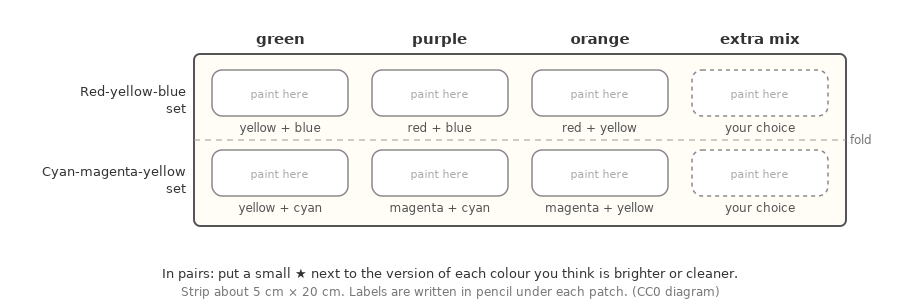
- Look and decide (5 min). In pairs, pupils compare the two rows. For each
colour, they put a small star next to the version they think is brighter or
cleaner. Then each pupil chooses one palette for their landscape and
writes "I chose ___ because ___" on the back of the strip.
- Paint the landscape (25-30 min). Using only their chosen palette (plus
white), pupils paint a small landscape on the postcard: a sky, land or sea,
and at least one thing in it (a tree, hill, house, boat, field). Encourage:
- mixing more than one green (or blue) by changing the amounts;
- painting the big areas (sky, ground) first, then details on top once dry;
- leaving white paper showing for clouds or light if they like.
- Tidy and dry (5 min). Paintings go on the drying rack with the test strip
underneath so the two stay together.
Discussion questions (with answers)
- Which palette mixed the brighter green in your test? Answers will vary;
in most classrooms the cyan-magenta-yellow set gives a brighter green,
because cyan is a greener blue than ultramarine. Accept any answer that
points to the strip.
- Which mixed the brighter purple? Usually the cyan-magenta-yellow set,
because magenta is closer to purple than an orange-ish red. Accept what the
strip shows.
- Was there anything the red-yellow-blue set did better? Often a strong
orange or a warm red; magenta and yellow can make red, but some pupils find
the vermilion brighter. This is one reason many painters still like
red-yellow-blue palettes.
- Are red, yellow and blue "the" primary colours? No; they are one set that
painters have used for a long time. Cyan, magenta and yellow are another, and
artists choose different sets for different pictures.
- Why did you choose your palette for this landscape? Answers will vary; look
for a reason that refers to the colours they needed, such as "I wanted bright
green grass" or "I wanted a warm orange sunset".
Closing check (5 min, with answers)
Each pupil holds up their painting and test strip to a partner and answers:
- Point to the two patches on your strip that show the biggest difference
between the palettes. Any pair where one is clearly cleaner or brighter.
- Name one colour in your landscape that you mixed, and the colours you mixed
it from. For example "light green: yellow, a bit of cyan and white".
- True or false: "Every set of three paints mixes the same colours." False;
different starting colours mix different ranges, as the strip shows.
Vocabulary
- palette: the set of colours a painter chooses to start with (also the tray
they mix on).
- primary colours (of a palette): the starting colours you mix everything
else from. Different palettes have different primaries.
- cyan, magenta: a bright turquoise-blue and a bright pink-purple, used by
printers as starting colours.
- landscape: a picture of a place outdoors.
Differentiation
- Support: pre-squeeze small blobs of each paint; let pupils test only green
and purple; offer a pencilled horizon and one simple shape (a hill) to paint.
- Stretch: pupils add white to make a paler version of one mix in each row
and compare again; or paint a second, tiny landscape with the other palette
and compare the two pictures.
- Colour vision: pairs describe the patches as lighter/darker or
duller/brighter; labels in words on every pot and patch.
Safety
- Non-toxic paint suitable for children; no brushes or fingers in mouths.
- Aprons on; wipe spills straight away; wash hands after painting.
- Keep water pots low and central; carry with two hands.
Teacher notes
- Try both sets before the lesson. Results depend on the actual paints. If
your "blue" is already turquoise or your "red" is already pinkish, the
difference will be small. That is fine: the point is that pupils test and
decide, not that one set wins.
- Don't pre-announce a winner. Let the strips do the arguing. If a pupil
prefers the red-yellow-blue set, ask what it did better; that is a real
artistic reason.
- Common misconception: "Red, yellow and blue are the only real primary
colours." This is widely taught (many adults learned it at school). It is a
long tradition in painting, not a fact about colour. See the unit sources.
- If pupils ask about screens: screens mix light, not paint, and their
starting colours are red, green and blue light. That is a different kind of
mixing; it comes up again in science.
- Keep the landscapes; pupils will compare them with their lesson 4 painting.