Lesson 4: Open space in Treasure Lanes and wheel & helmet safety
Unit overview - Previous: Lesson 3 - Next: Lesson 5
Goal: Students spot and move into open space and apply simple chasing and
fleeing tactics in a non-elimination team game (Treasure Lanes), and explain
four practical wheel-and-crossing safety habits including proper helmet fit and
taking helmets off before using playground equipment.
Length: 35 minutes (opening 3, warm-up 5, main activity 18, cool-down and
discussion 6, closing check 3).
Materials
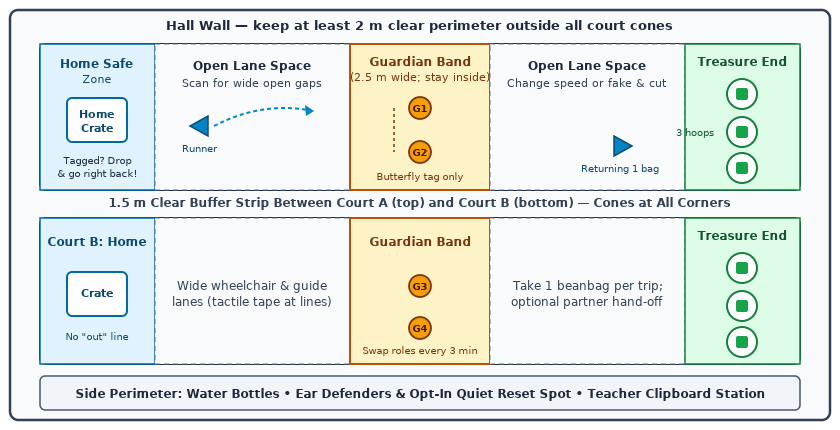
- Cleared hall/court set up with two parallel Treasure Lanes courts inside a
2-metre clear perimeter buffer (see diagram below):
- Per court: floor tape or flat cones marking a Home Safe Zone (left, with
1 crate), an Open Approach Zone, a central 2.5-metre Guardian Band
(where 2 or 3 guardians move laterally), a second Open Zone, and a
Treasure End (right, with 3 spaced hoops holding 12 beanbags total).
- 6 freshly washed high-contrast sashes/pinnies for guardians, plus soft foam
pool-noodle reach extensions (about 50 cm) for optional no-contact or
wheelchair tagging.
- Combined sound + sight stop signal, six dynamic warm-up cards and three
cool-down cards.
- Wheel & Helmet Safety demonstration kit:
- 1 clean bicycle/scooter helmet fitted onto a prop ball or large melon
(students never share headwear), showing the expanded-polystyrene foam
liner inside and adjustable cradle/straps.
- A bicycle bell and clip-on white front light + red rear light (or bold
printed picture cards if real lights/bell are unavailable).
- Four Wheel Safety Scenario Cards (Card 1: Eyebrow-high tilted helmet;
Card 2: Keeping a bike helmet on while climbing the monkey bars; Card 3:
Riding past a driveway with hedges and a parked car at dusk; Card 4:
Passing a family walking ahead on a shared path).
- Tactile tape under court zone lines and crinkle/bell beanbags for blind or
low-vision learners; water, ear defenders, quiet reset spot and clipboard.
Steps
Opening (3 min)
Gather where everyone can see Court A. Point out the zones on the floor:
"Today nobody is ever 'out'. In Treasure Lanes, runners look for open space—a
wide lane where no guardian is standing—cross the Guardian Band to collect one
beanbag from a Treasure Hoop, and bring it back to the Home Crate." Review safe
butterfly tag from Grade 1: guardians stay strictly inside the 2.5-metre
Guardian Band and tag only with a gentle open-hand tap on the shoulder,
upper arm or upper back (or a light tap on shoulder/chair frame with a soft foam
noodle—never grabbing shirts, arms or chairs). If tagged while empty-handed,
simply jog/roll back to the Home Safe Zone and go straight back in; if tagged
while carrying a beanbag, place the beanbag back in a Treasure Hoop, touch the
Home Safe Zone, and immediately try again!
Warm-up (5 min)
Run the six dynamic warm-up cards around the outer perimeter, then spend 90
seconds practising defensive side-slides (knees softly bent, feet gliding
without crossing—or crisp forward/reverse chair pivots) and outside-foot
plant-and-cut changes of direction in open space so ankles and knees are
primed for chasing and fleeing.
Main activity (18 min)
- Round 1 — Spot the open lane (5 min). Put 6–8 students per half-court
(for example 5–6 runners vs. 2 guardians on Court A and Court B; if the
class is larger than 18, add a third parallel strip or rotate a 2-minute
coach-observer pair who spot open lanes from the side).
- Play for 3 minutes, then pause on the stop signal and ask: "Runners, what
happened when three of you ran straight at the same guardian?" (Crowded
space made tagging easy.) "Where was the open space?" (
S2.E1.3:
the unguarded far side of the band!) Swap guardians so everyone plays both
roles.
- Round 2 — Chasing & fleeing tactics huddle (7 min). Teach two explicit
tactics on each side (
S2.E5.3a, S2.E5.3b, S2.E3.3):
- Fleeing tactics (Runners): (a) Scan before leaving safety—spot the
widest gap first; (b) Change speed or fake-and-cut—approach at an easy
pace, step one way to draw a guardian, then accelerate briskly through the
open lane; (c) Team decoy/split—two teammates enter at opposite edges of
the band at the same time so one guardian cannot cover both.
- Chasing tactics (Guardians): (a) Zone spacing—Guardian 1 covers the
left half of the band and Guardian 2 covers the right half instead of
bunching together on one runner; (b) Watch the runner's waist/hips,
sliding sideways smoothly rather than lunging off balance.
Play two 3-minute games with a guardian swap in the middle so every student
tests both chasing and fleeing tactics.
- Wheel & Helmet Safety hands-on huddle (6 min). Gather seated at the
centre buffer while heart rates begin to step down. Show the prop helmet on
the ball/melon (remind students we never share helmets head-to-head):
- Inside the helmet: point out the stiff expanded-polystyrene foam
liner designed to crush and absorb impact acceleration in a fall while
keeping vents open and peripheral vision clear. Point out that an unbuckled
or tipped-back helmet slides off the forehead right when needed—proper fit
matters enormously.
- Three-Point Helmet Fit Check (2-V-1 Self-Mime) (students mime with clean fingers on their
own brow, ears and chin): 2 finger-widths level above the eyebrows
(protecting the forehead without blocking sight); 2 fingers forming a
snug V-strap around each ear; 1–2 fingers fitting snugly between chin
and buckled strap.
- The Playground Rule (CPSC strangulation warning): "Helmet ON for
wheels (bike, scooter, skates); helmet OFF before climbing playground
frames or trees!" Explain plainly why: a helmet or strap can wedge in
bars or branches and strangle a climber.
- Quick Scenario Sort (Cards 1–4): hold up the white front light, red
rear light and bell, and solve the 4 quick cards together:
- Card 1 (Tilted back like a sunhat, unbuckled): Fix level 2-finger brow
height + buckle snug chin strap.
- Card 2 (Parking scooter and running onto monkey bars wearing helmet):
Take helmet off first and clip/leave it with the scooter!
- Card 3 (Driveway with high hedge + parked car at dusk): Dusk glare/low
light is high-risk—use white front & red rear lights + bright/reflective
gear, watch for car doors opening (dooring) and reversing cars, and
stop at the driveway edge to Stop, Look, Listen, Think.
- Card 4 (Approaching pedestrians on a shared path): Slow down early,
ring a bell or call "Passing on your left/right, thank you!" with
plenty of space.
Cool-down and discussion questions (6 min)
- Active cool-down (3 min). Students help stack beanbags in the crates,
then walk/roll two calm perimeter laps using the three cool-down cards (slow
stroll, gentle calf/hip stretches at the edge, four-count breathing).
- Discussion questions (3 min):
- "When you were a guardian in Treasure Lanes, why did splitting into left
and right zones work better than both chasing the same runner?" (Answer
guide: chasing one runner together opens a huge unguarded lane for every
other teammate; covering zones closes open space.)
- "Why must you always take your bike or scooter helmet OFF before climbing
on playground equipment or a tree?" (Answer guide: the helmet shell or
chin strap can catch in bars or branches and cause strangulation.)
- "What helps drivers and walkers notice a cyclist or scooter rider early,
especially late in the afternoon?" (Answer guide: bright or reflective
clothing, a white front light and red rear light, good positioning away
from blind spots and car doors, a bell or clear voice warning, and
stopping to Stop, Look, Listen, Think at driveways and crossings.)
Closing check (3 min)
Call three quick rapid-check prompts; students answer with a partner in 20
seconds each:
1. Name one fleeing tactic you used to beat the Guardian Band (scan for an
open lane, change speed, plant-and-cut fake, split wide with a teammate).
2. Mime the three-point helmet fit check (2-V-1) on your own brow, ears and chin.
3. Thumbs up (safe) or flat time-out T (unsafe): "Sam locks his bike and climbs
the climbing frame with his helmet still buckled on." (Flat T—helmet comes
off before playground climbing!)
Vocabulary
open space, tactic, lane, zone coverage, plant-and-cut, expanded polystyrene
liner, peripheral vision, reflective
Differentiation
- Support: widen the court or reduce guardians from 3 to 2 so open lanes
are easier to spot; allow runners up to 8 seconds inside a Treasure Hoop to
plan their return path.
- Stretch: add a cooperative relay pass rule—runners may pass the
beanbag underhand across the Guardian Band to a teammate who has cut into an
open space on the Home side!
- Early finishers / side observers: act as "Space Spotters" for 90 seconds,
pointing out which side of the Guardian Band opened up on a successful run.
Safety
- Guardians stay inside the taped 2.5-metre Guardian Band so nobody chases
a runner from behind toward a wall or hoop.
- Butterfly tag only (shoulder, upper arm, upper back, or soft foam noodle tap);
never dive, slide on knees, or step onto hula hoops (use flat spot markers or
soft non-slip hoops if the floor is slick).
- Never pass a demonstration helmet from student head to student head.
Teacher notes
- SHAPE America Grade 3 outcomes addressed:
S2.E1.3 (recognizes open spaces
in a movement context), S2.E3.3 (combines movement concepts—direction,
levels, force, time—with skills), S2.E5.3a (simple strategies and tactics in
chasing activities—first appears in Grade 3), S2.E5.3b (simple strategies in
fleeing activities—first appears in Grade 3), and S4.E6.3 (works
independently and safely).
- Helmet and cycling notes follow the
Bicycle helmet, Cycling safety and
Green Cross Code sources; check your local jurisdiction's rules on child
helmet laws, footpath riding, and left- vs. right-hand traffic look order.