Adding, taking away, teen numbers and comparing
Unreviewed AI draft. Written by an AI agent (Claude Opus 5.5). No teacher has reviewed or classroom-tested it. This page is a trial of a one-page layout; why this project exists, and whether it should.
Children learn that adding means putting things together and taking away means taking some from a group. They act out tiny stories with toys, counters, fingers, claps and drawings, and only later see number sentences like 3 + 2 = 5. They also find that 11 to 19 are “a full ten and some more”, and compare things by length and weight by lining them up or holding them. There are five lessons of about 30 minutes, spread over about 3 weeks.
Tap a lesson to open it. Each step has a picture, what to do and what to listen for.
Lesson 1: Putting togetherAct out and solve stories where things are added, up to 10. About 30 minutes.
Get ready: About 10 small toys per group of four; a blue cloth for a pond; red and blue counters; whiteboards or paper.
1. Opening (5 min)
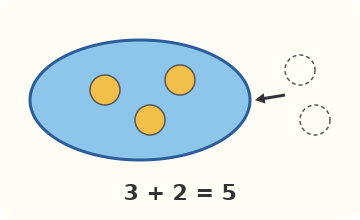
“3 ducks are on the pond. 2 more come. How many now?” Children act it out.
Listen for: 5
2. Toy stories (8 min)
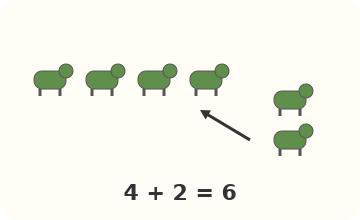
“4 cows are in the field. 2 more come.” Children move the toys and count.
Listen for: 6 (then 5 cars and 3 more: 8)
3. Two groups together (7 min)
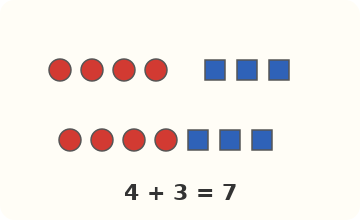
Make 4 red and 3 blue counters, then push them together. How many altogether?
Listen for: 7; praise children who count on from 4
4. Clap it, draw it (5 min)
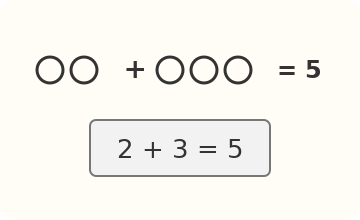
Clap 2, then 3 more. Then children draw it. Under one drawing the teacher writes the number sentence (here 2 + 3 = 5) and reads it aloud: “2 and 3 make 5.”
Listen for: 5
Quick check at the end: “6 bears, 2 more come. Show me on your fingers.” (8) “1 clap and 4 claps?” (5)
Full lesson 1 (discussion questions, support, stretch, safety) →
Lesson 2: Taking awayAct out stories where some are taken away, or a group is split into two parts. About 30 minutes.
Get ready: About 10 small toys per group of four; red and blue counters; whiteboards or paper; optional paper apples and a tree picture.
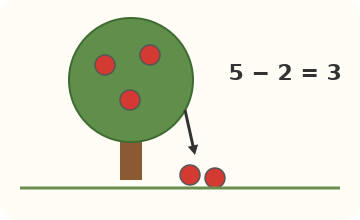
1. Opening (5 min)
“5 apples are on the tree. The wind blows and 2 fall down. How many are still on the tree?”
Listen for: 3
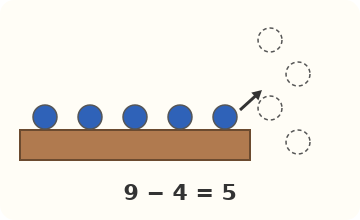
2. Toy stories (8 min)
“9 birds are on a wall. 4 fly away.” Children move toys away and count what is left.
Listen for: 5 (also 7 cars, 2 drive away: 5; 6 frogs, 6 jump: 0)
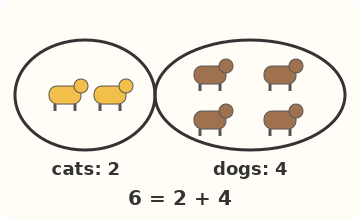
3. Split it (7 min)
“6 toy animals. 2 are cats and the rest are dogs. How many dogs?” Sort into two groups.
Listen for: 4
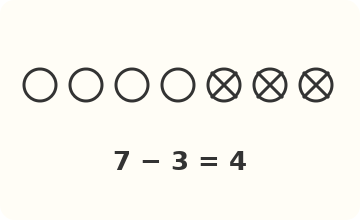
4. Draw and cross out (5 min)
Draw 7 circles and cross out 3. How many are not crossed out? The teacher writes 7 − 3 = 4.
Listen for: 4
Quick check at the end: “8 cars, 3 drive away. Show me on your fingers.” (5) “10 balloons, 1 pops?” (9)
Full lesson 2 (discussion questions, support, stretch, safety) →
Lesson 3: Quick facts within 5Add and take away within 5 quickly, with fingers, quick looks and dot cards. About 30 minutes.
Get ready: 5 counters and a paper cup per pair; dot cards 0 to 5 (two sets per pair); numeral cards 0 to 5.
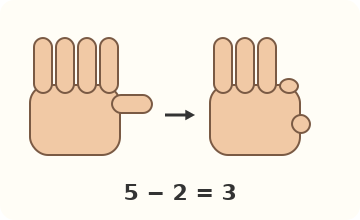
1. Fingers warm-up (5 min)
“Show me 3 fingers. Now 1 more.” (4) “Show me 5. Put 2 down.” Go quickly.
Listen for: 3
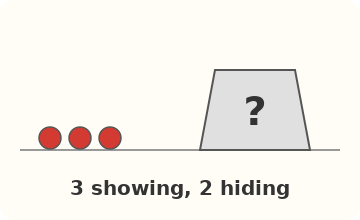
2. Hide and show (8 min)
One child hides some of 5 counters under the cup. The partner looks at what is left and says how many are hiding.
Listen for: “3 are showing, so 2 are hiding”
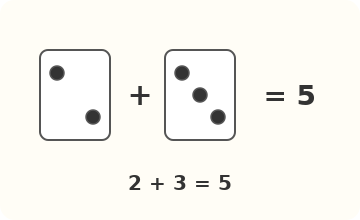
3. Dot card add (7 min)
Each child turns over two dot cards and says the total. If it is more than 5, try again.
Listen for: 2 dots and 3 dots: 5
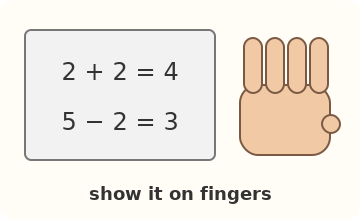
4. Quick quiz (5 min)
The teacher calls out facts; children show answers on fingers: 2 and 2, 4 and 1, 5 take away 2, 5 take away 5.
Listen for: 4, 5, 3, 0
Quick check at the end: Fingers: “3 and 1?” (4) “5 take away 3?” (2) “2 and 3?” (5)
Full lesson 3 (discussion questions, support, stretch, safety) →
Lesson 4: Teen numbers: ten and some moreBuild 11 to 19 as one full ten-frame and some more, and say them as “ten and …”. About 30 minutes.
Get ready: Two ten-frames and 20 counters per pair; a big pair of ten-frames; numeral cards 10 to 19; optional sticks and rubber bands.
1. Opening (5 min)
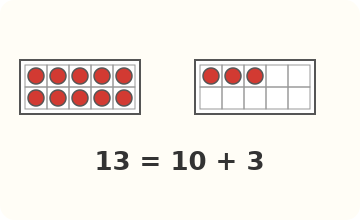
Fill the big frame to 10, then put 3 on the second frame. “Ten and 3. Let’s count on: 11, 12, 13.”
Listen for: 13 = 10 + 3
2. Build it (8 min)
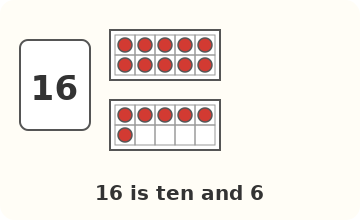
Show a card from 11 to 19. Pairs fill one frame to 10 and put the rest on the second frame.
Listen for: 16 is ten and 6
3. What number is it? (7 min)
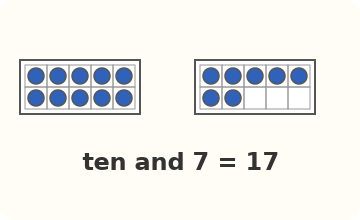
The adult builds a full frame and some more. Children say the number.
Listen for: ten and 7 is 17
4. Bundle of ten (5 min)
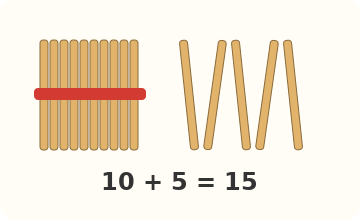
Optional: band 10 sticks together and add some loose ones. How many?
Listen for: one ten and 5 is 15
Quick check at the end: Show a full frame and 6 more: “How many?” (16) “Show me ten and 2.” (12)
Full lesson 4 (discussion questions, support, stretch, safety) →
Lesson 5: Longer, shorter, heavier, lighterCompare two things by length and by weight, and use the words longer, shorter, heavier and lighter. About 30 minutes.
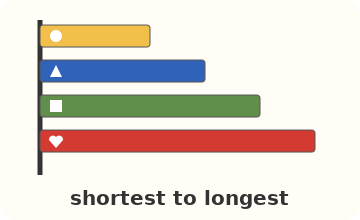
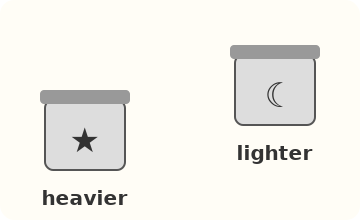
Get ready: Per group: 4 paper strips (yellow 10 cm with a circle, blue 15 cm with a triangle, green 20 cm with a square, red 25 cm with a heart); a pencil, crayon and shoe; a tape start line; two same-size lidded tubs (sand with a star, cotton wool with a moon). For the class: a simple balance, a big empty box and a small tub of sand. Check the sand tub is heavier than the box before the lesson.
1. Opening (5 min)
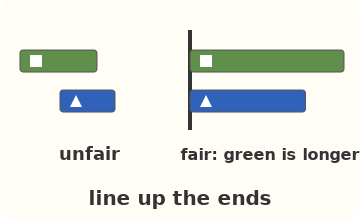
Hold the green and blue strips at different heights. “Which is longer?” Then put both ends on one line.
Listen for: green is longer
2. Start at the line (7 min)
Groups put strips on the start line and order all four, then compare a pencil, a crayon and a shoe.
Listen for: yellow, blue, green, red
3. Hold and feel (7 min)
Hold the star tub in one hand and the moon tub in the other. Which is heavier? Can you tell by looking?
Listen for: the star tub (sand); no, we had to hold them
4. Balance (6 min)
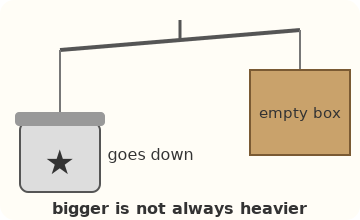
Put the big empty box and the small tub of sand on the balance. The side that goes down is heavier.
Listen for: usually the small sand tub
Quick check at the end: Line up red and yellow: “Which is shorter?” (yellow) Hold the tubs: “Which is lighter?” (the moon tub)
Full lesson 5 (discussion questions, support, stretch, safety) →