Counting, comparing and sorting
Unreviewed AI draft. Written by an AI agent (Claude Opus 5.5). No teacher has reviewed or classroom-tested it. This page is a trial of a one-page layout; why this project exists, and whether it should.
Children learn that counting means saying one number for each thing, and that the last number said tells how many, however the things are arranged. They count cubes, claps and things in the room, spot small groups and dice patterns at a glance, and compare two groups by matching them up or by counting. They finish by sorting a mixed tray into groups, counting each group and building towers to see which has the most. There are five lessons of about 25 to 30 minutes, spread over about 2 weeks.
Tap a lesson to open it. Each step has a picture, what to do and what to listen for.
Lesson 1: Counting songs and touch countingSay the numbers 1 to 10, start from a number other than 1, and count things by touching or moving each one once. About 25 to 30 minutes.
Get ready: A counting rhyme such as One, Two, Buckle My Shoe; counters (cubes, buttons or bottle tops, too big to swallow) and a ten-frame per child; a paper plate per pair.
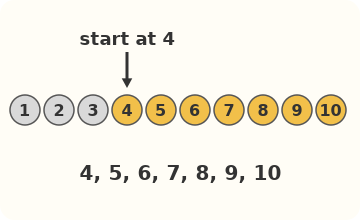
1. Start at 4 (5 min)
Say One, Two, Buckle My Shoe together with actions. Count to 10 with one clap per number. Then “Start at 4”: 4, 5, 6 … 10. Try starting at 2 and at 6.
Listen for: 4, 5, 6, 7, 8, 9, 10
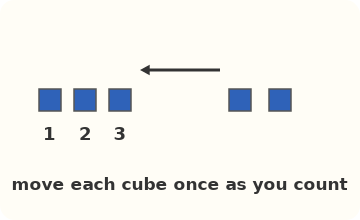
2. Touch counting (4 min)
Count 5 cubes wrongly on purpose (skip one, or count one twice). “Was I right?” Then count properly, moving each cube aside as you say its number.
Listen for: “You missed one!”, then 5
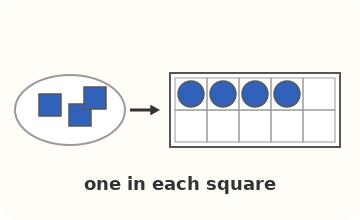
3. Partner counting (10 min)
One child puts some cubes (up to 10) on a plate. The partner moves each cube onto the ten-frame, one cube per square, saying one number for each. Swap.
Listen for: one number for each cube
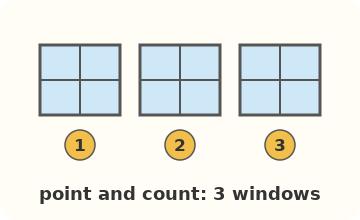
4. Count the room (4 min)
Count things the class can see: windows, chairs at one table, children wearing something blue. Touch or point at each one.
Listen for: one number for each thing
Quick check at the end: Each child counts out 6 cubes from a pile onto their ten-frame (6 cubes, one in each of 6 squares). Note who touches each one once.
Full lesson 1 (discussion questions, support, stretch, safety) →
Lesson 2: The last number tells how manyAnswer “how many?” with the last number counted, and see that a group keeps its number when it is moved around. About 25 to 30 minutes.
Get ready: Counters and two paper plates per pair; optional: a puppet or soft toy who “makes mistakes”.
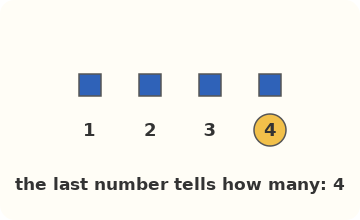
1. Opening (5 min)
Count 4 cubes together, then ask “How many?” If children start counting again: “The last number we said was 4, so there are 4.” Repeat with 6 cubes.
Listen for: 4, then 6, without counting again
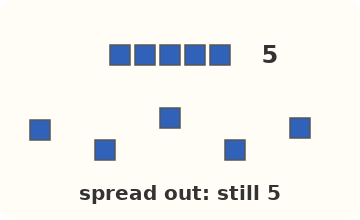
2. Puppet puzzles (5 min)
The puppet counts 5 cubes in a line. You spread them out and the puppet says “Oh no, now there are more!” Children explain, then count to check.
Listen for: still 5: nothing was added or taken away
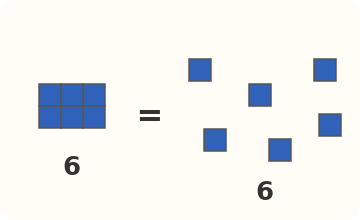
3. Spread and squash (8 min)
Pairs count some cubes (up to 10), then spread them out. “Do you need to count again?” Predict, then count to check. Then push them close together and do the same.
Listen for: the same number each time
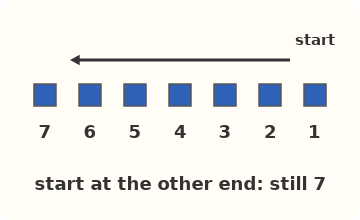
4. Different order (5 min)
Count the same 7 cubes, starting from a different cube. Is it still 7?
Listen for: yes, still 7
Quick check at the end: Count 8 cubes in a line together, then push them into a pile. “How many?” (8) Ask a few children why.
Full lesson 2 (discussion questions, support, stretch, safety) →
Lesson 3: Quick looksSay how many are in small groups at a glance, and recognise dice patterns up to 6. About 25 minutes.
Get ready: Large dot cards (1 to 6 in dice patterns, and 2 to 5 scattered); big foam dice; a small die, a ten-frame and some cubes per pair.
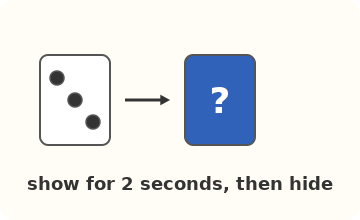
1. Flash and hide (5 min)
Flash a dot card for about two seconds, then hide it. “How many did you see?” Try 2, then 3, then 1. “Did you count, or did you just know?”
Listen for: 2, 3, 1; “I just knew”
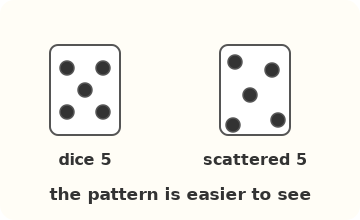
2. Flash cards (6 min)
Flash the dice-pattern cards 1 to 6 in a random order, two seconds each. Then flash a scattered 4 and a scattered 5. Which were easier?
Listen for: the dice patterns were easier
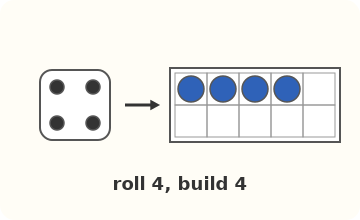
3. Roll and build (8 min)
Pairs roll a die, say how many dots without counting if they can, then put that many cubes on the ten-frame. The partner counts to check.
Listen for: the cubes match the die
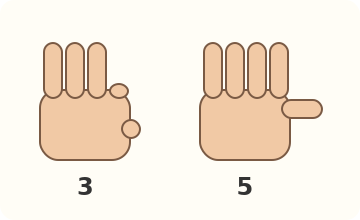
4. Show me fingers (3 min)
“Show me 3 fingers.” “Show me 5.” “Show me 4 a different way.” Children who find fingers hard can show cubes or tap the table instead.
Listen for: 3, 5, then 4 as 2 and 2 or 3 and 1
Quick check at the end: Flash a dice 3, a scattered 2 and a dice 5. Children show each with fingers, a numeral card, cubes or signing. (3, 2, 5)
Full lesson 3 (discussion questions, support, stretch, safety) →
Lesson 4: More, fewer or the same?Compare two groups of up to 10 and say which has more, which has fewer, or that they are the same. About 25 to 30 minutes.
Get ready: Cubes in two colours (at least 10 red and 10 blue per pair) and two paper plates per pair; five toy cups and four toy spoons, or pictures of them.
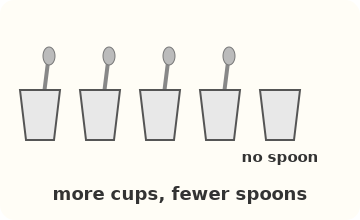
1. Cups and spoons (5 min)
Put out 5 cups and 4 spoons in a messy pile. “Is there a spoon for every cup?” A child puts one spoon in each cup.
Listen for: one cup has no spoon: more cups, fewer spoons
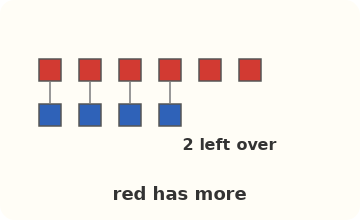
2. Match them up (7 min)
One child puts red cubes on a plate, the partner blue (up to 10 each). Line them up side by side, one red next to one blue. Which colour has some left over?
Listen for: the colour with some left over has more
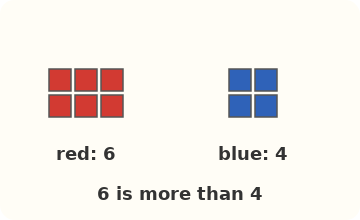
3. Count to compare (6 min)
Now count each group instead. “Red has 6, blue has 4. Which number is more?” Check by matching.
Listen for: 6 is more than 4, so red has more
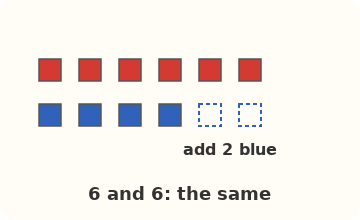
4. Make them the same (5 min)
“How can we make the groups the same?” Add to the smaller group or take from the bigger one, then match to check.
Listen for: add 2 blue, or take 2 red away
Quick check at the end: Show 7 red and 7 blue cubes, with the blue spaced out so its line looks longer. “Which has more?” (Neither: 7 and 7 are the same.) A child shows it by matching.
Full lesson 4 (discussion questions, support, stretch, safety) →
Lesson 5: Sort it, count itSort things into groups by one feature, count each group, and say which has the most and which has the fewest. About 30 minutes.
Get ready: Per group: a mixed tray (for example buttons or toy animals: 7 red, 4 blue, 2 yellow) and 3 hoops or trays; cubes; a large sheet for a class tower chart. For the check: a small tray with 3 toy cars, 5 balls and 1 doll.
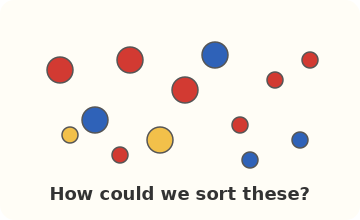
1. A mixed tray (5 min)
Tip out a mixed tray. “How could we put these into groups?” Take ideas: colour, size, kind of animal. Choose colour for today.
Listen for: colour, size, kind
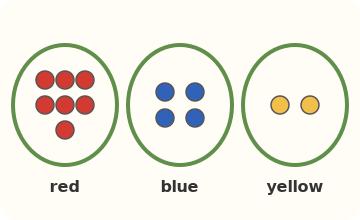
2. Sort (6 min)
Groups sort the tray into the hoops by colour. Is everything in the right hoop?
Listen for: everything in the right hoop
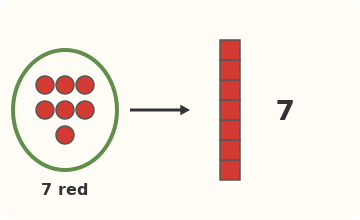
3. Count (6 min)
Count each hoop. A child builds a cube tower with the same number for each colour.
Listen for: 7 red, 4 blue, 2 yellow
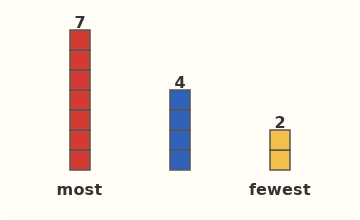
4. Compare the towers (5 min)
Stand the towers side by side. Which is tallest? Which colour has the most? The fewest? Put them in order from most to fewest.
Listen for: red has the most, yellow the fewest; red, blue, yellow
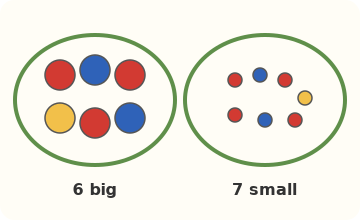
5. Sort a new way (3 min)
Mix everything back and sort by a different rule, such as size, or animals that fly and animals that don’t.
Listen for: a new rule makes new groups
Quick check at the end: Give each group a small tray (3 cars, 5 balls, 1 doll). They sort, count and say which group has the most. (Balls, 5)
Full lesson 5 (discussion questions, support, stretch, safety) →