Lesson 3: Can we see in the dark?
Unit overview - Previous: Lesson 2 - Next: Lesson 4
Goal: Children find that we can see things only when there is light:
light shines on them, or they give off their own light. They tell light
sources from shiny things.
Length: about 40 minutes.
Materials
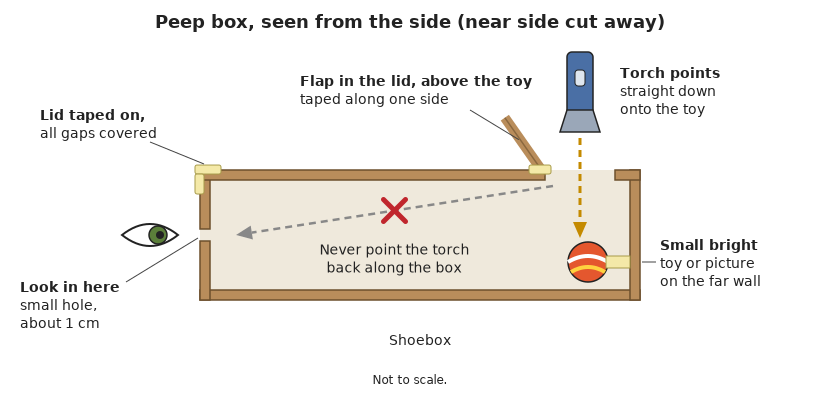
- One peep box per group: a shoebox with the lid taped on and all gaps
covered, a small hole (about 1 cm) in one end to look through, and a flap
cut in the lid at the far end, above the toy (taped along one side), that
opens to let light in. Inside,
a small bright toy or picture stuck to the far wall. Make these before the
lesson and check that, with the flap shut, the inside looks dark.
- One small LED torch per group (battery cover screwed shut).
- Per group: a glow-in-the-dark star (charged under a lamp before the
lesson, and again with the group's torch for about 30 seconds just before
it goes in the box), a piece of kitchen foil with folded edges, a plastic safety
mirror.
- Picture cards: Sun, candle flame, lamp (switched on), torch (switched on),
Moon, mirror, spoon, foil.
Two sorting mats: "makes its own light" (a picture of a lamp shining) and
"does not make its own light" (a picture of a closed box).
- Optional: a phone camera, to photograph the inside of a box (flap shut and
flap open) for children who cannot look through the hole.
- Whiteboards and pens, or paper and pencils.
Steps
Opening (5 min)
Safety first: "Never look at the Sun. Never shine a torch into anyone's
eyes." Children repeat it with actions (hands over eyes; torch pointing
down). Then: "If you were in a cupboard with the door shut and no light at
all, could you see your hand?" Take guesses; do not give the answer yet.
Main activity (25 min)
- Peep box, flap shut (7 min). Each child in turn looks through the
hole with the flap shut. "What can you see?" (Nothing, or only darkness.)
Children draw what they saw (a dark box). Nobody says what is inside yet.
- Flap open, or torch in (8 min). Open the flap a little, or the torch holder
shines the torch straight down through the flap onto the toy,
pointing away from the peephole end, never back along the box. Look again. "What can you see now?" (The toy or
picture.) Shut the flap again: it disappears. Children draw the second
picture next to the first.
- What makes light? (10 min). With the flap shut, recharge the glow
star with the torch, put it inside and look. (It can be seen, faintly: it gives off its own
light.) Take the star out. Then put the foil and the mirror inside with the flap shut. (They
cannot be seen: they are shiny, but they do not make light.) Groups sort
the picture cards onto the two mats.
Discussion questions (5 min, with answers)
- Why could you not see the toy with the flap shut? There was no light in
the box, and we need light to see things.
- Back to the cupboard: with the door shut and no light at all, could you
see your hand? No. Like the toy in the shut box, we need some light to
see.
- The foil is shiny. Why couldn't we see it in the dark box? Shiny things
do not make their own light; they only bounce light that shines on them.
- Is the Moon a light source? No. The Moon looks bright because sunlight
shines on it and bounces off. (Accept "it looks like one"; this is
surprising for many adults too.)
Closing check (5 min, with answers)
Show the torch, the glow star, the foil and the mirror. "Which ones make
their own light?" (Torch, glow star.) "Which only shine when light is on
them?" (Foil, mirror.) "Could you see the toy in the box with no light at
all?" (No.) Children answer by pointing, signing, saying or sorting.
Vocabulary
light, dark, light source, shiny, bounce, glow, see
Differentiation
- Support: sort only the torch, a lamp card, foil and a mirror.
- Stretch: "A cat walks into a room with no light at all. Can it see?"
(No. Cats see well in dim light, but they still need some light.)
Safety
- Never look at the Sun; never shine torches into eyes.
- In the peep box, the torch always points down onto the toy, away from the
peephole, while a child is looking.
- The classroom stays lit; the dark is inside the box only.
- Plastic safety mirrors only; fold the foil edges over.
- Glow sticks, if used instead of stars, stay closed and are not bitten.
Access
- Children who dislike the dark only look into a small box; they never sit
in the dark.
- Blind and low-vision children can feel the objects inside the open box and
take the "sorting" role; a partner describes what they see through the
hole. Some low-vision children can tell the torch on or off by brightness.
- Children who cannot hold their eye to a hole can look at a photograph
taken through the hole with a phone camera, flap shut and flap open.
Teacher notes
- Timing: 5 + 25 (7 + 8 + 10) + 5 + 5 = 40 minutes.
- A common idea at this age is that our eyes "get used to" the dark and
will see eventually. In a truly dark box they do not; if a child sees a
little, look for a gap letting light in and tape it.
- The standard's clarification statement suggests a pinhole box or a
completely dark room; this unit uses the box so no child has to be in the
dark.