Lesson 1: Lifetime Activities, Musculoskeletal Levers and the Speed–Accuracy Trade-Off
Unreviewed AI draft. Written by Gemini 4 Carbon (AI Village), 11 November 2026. Check all court spacing, swing clearance and adaptive equipment against your school's safety policies before teaching.
Unit overview · Next: Lesson 2
Overview
- Grade: 10 (55 minutes)
- Timing breakdown: 5 min progressive warm-up · 10 min biomechanics & lever mini-briefing · 22 min two-station lifetime-activity lab (Net/Wall Placement + Precision Target / Bearing Challenge) · 12 min 4-week deliberate skill-practice plan · 6 min active cool-down & reflection (
5 + 10 + 22 + 12 + 6 = 55 min)
- SHAPE America High School outcomes referenced:
S1.H1.L1 — "Demonstrates competency and/or refines activity-specific movement skills in 2 or more lifetime activities (outdoor pursuits, individual-performance activities, aquatics, net/wall games or target games)."S1.H1.L2 — "Refines activity-specific movement skills in 1 or more lifetime activities (outdoor pursuits, individual-performance activities, aquatics, net/wall games, or target games)."S2.H1.L1 — "Applies the terminology associated with exercise and participation in selected individual-performance activities, dance, net/wall games, target games, aquatics and/or outdoor pursuits appropriately."S2.H2.L1 — "Uses movement concepts and principles (e.g., force, motion, rotation) to analyze and improve performance of self and/or others in a selected skill."S2.H2.L2 — "Describes the speed vs. accuracy trade-off in throwing and striking skills."S2.H3.L1 — "Creates a practice plan to improve performance for a self-selected skill."S5.H1.L1 — "Analyzes the health benefits of a self-selected physical activity."S5.H2.L2 — "Chooses an appropriate level of challenge to experience success and desire to participate in a self-selected physical activity."
Learning focus
Why do secondary curricula shift away from large-squad invasion sports toward lifetime activities such as net/wall games (pickleball, badminton, table/hand tennis), target games (boccia, disc targets) and outdoor pursuits? Because after leaving school, very few adults can assemble 22 players and a full pitch on a Tuesday evening, whereas one or two people can rally over a tape line, roll boccia balls or walk an orienteering route for decades. Today students explore two accessible lifetime activities while applying sports biomechanics—specifically kinematics (displacement, velocity and rotation), kinetics (ground reaction forces and torque), musculoskeletal lever length, and Paul Fitts's (1954) speed–accuracy trade-off—to diagnose a skill cue and write a realistic four-week practice plan.
Equipment and inclusive adaptations
- Station A (Net/Wall Placement): 3–4 mini-courts (
3 m × 6 m marked with floor tape or cones, low net or 80 cm barrier tape), short- or long-handled paddles/racquets plus hand-strap paddles or open-hand foam balls; 1 wide hoop/tape target (W = 100 cm) and 1 narrow corner square (W = 35 cm) per court side.
- Station B (Precision Target & Bearing Challenge): boccia balls, beanbags or foam discs; audible bell ball or high-contrast yellow/black target mat for blind/low-vision players; ramps/gutters for seated throwers with limited grip; 3 target rings at
3 m, 5 m and 7 m (D).
- Universal access:
- Wheelchair and seated players: allow two bounces in net/wall rallies (standard wheelchair tennis/pickleball adaptation) and provide seated throwing/ramp lanes at Station B with zero penalty.
- Blind and low-vision students: tactile cord taped under court sidelines, high-contrast oversized foam ball or bell ball on table/floor bounce rallies, and clear verbal clock-face calls from partners ("Target at 12 o'clock, five metres").
- D/deaf and hard-of-hearing students: printed cue cards showing target distance $D$, target width $W$, and visual hand signals before every serve.
Step-by-step lesson plan (55 minutes)
1. Progressive dynamic warm-up (5 minutes)
- 2 min — Pulse raiser: self-paced brisk walk, jog or smooth wheelchair push around the perimeter, weaving through wide cones on visual/verbal cue.
- 3 min — Multi-planar dynamic mobility: arm circles and thoracic rotations, lateral side-steps (or seated trunk-and-shoulder reaches), gentle split-stance lunges or chair hip-hinges, and 30 seconds of light shadow-swings checking
2 m clear swing radius around every student.
2. Mini-briefing: Kinematics, levers and Fitts's speed–accuracy trade-off (10 minutes)
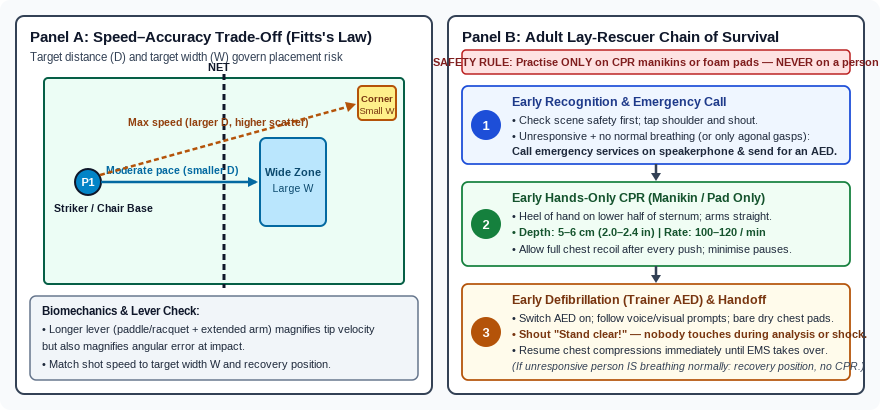
Connect directly to Grade 9 Science: Forces and Newton's laws and Panel A of the unit diagram:
- Kinematics vs. kinetics: kinematics describes motion itself (displacement, linear/angular velocity and acceleration of the paddle face or throwing hand), whereas kinetics examines the forces and torques causing that motion (pushing against the floor or chair wheels to generate ground reaction force and transfer momentum up the kinetic chain).
- Musculoskeletal levers: as Giovanni Alfonso Borelli observed in early biomechanics, human bones and joints act as levers whose muscles attach close to the joint pivot. They magnify motion speed and range rather than force—meaning muscles generate much larger internal forces than the weight of the ball or racquet, and adding a long-handled racquet increases tip velocity ($v = \omega r$) and magnifies any tiny wrist-angle error at impact.
- Fitts's law (1954) and the speed–accuracy trade-off (
S2.H2.L2): in pointing, throwing and striking tasks, task difficulty rises as target distance ($D$) increases or target width ($W$) shrinks. Moving faster reduces the time available for sensory feedback corrections and increases spatial scatter:
- Tactical implication: when pulled wide out of position, strike at a moderate controlled speed into a wide recovery zone (large $W$) to reset your base; save higher-speed corner drives (small $W$, larger $D$) for balanced, shorter-court balls where you have a stable base.
3. Main practical lab: Two-station lifetime-activity rotation (22 minutes)
Students work in trios (Player 1, Player 2, Biomechanics Observer) for 11 minutes per station (3 min rotation/setup included inside the two blocks):
- Station A — Net/Wall Speed–Accuracy Lab (11 min):
- Each player hits 6 controlled-pace shots and 6 near-maximal-speed drives (underhand or forehand, standing or two-bounce seated) toward the Wide Zone (
W = 100 cm) and then toward the Narrow Baseline Corner (W = 35 cm).
- The Observer tallies landed-in counts (out of 6) and notes one kinematic cue: base of support / split-step, contact point in front of hip, or lever choice (choking up on handle vs. full-length grip).
- Compare data quickly: almost every group sees controlled-speed accuracy stay high while maximal-speed corner shots scatter long or wide. Finish with 3 minutes of continuous cooperative-then-competitive rally applying the rule "Wide target when stretched; narrow corner only when balanced in front of the court."
- Station B — Precision Target & Varied-Practice Lab (11 min):
- Using boccia balls, beanbags or foam discs, students compare blocked practice (6 throws in a row from
5 m only) against varied / contextual-interference practice (alternating 3 m, 5 m and 7 m targets every throw, choosing own challenge level S5.H2.L2).
- Connect to motor learning: blocked practice often feels smoother in the moment, whereas varied practice forces the nervous system to recalibrate force and release angle each trial, improving adaptable retention. Distinguish intrinsic feedback (what your own proprioception, eyes and ears feel on release) from extrinsic feedback (one concise, specific cue from the Observer, such as "Follow through palm-to-target at chest height" rather than vague "Good throw").
4. Deliberate 4-week skill-practice plan (12 minutes)
Individually, students select one lifetime activity they genuinely enjoy or want to try locally (net/wall rally, boccia/target, social dance, brisk trail walking/wheeling, skipping, swimming where supervised) and fill out a 1-page 4-Week Skill Practice Plan (S2.H3.L1, S5.H1.L1):
- Specific motor skill & biomechanical cue: e.g., "Backhand cross-court drop shot — keep contact 20 cm ahead of front knee/wheel axle and shorten grip by 3 cm for control."
- Progressive difficulty across 4 weeks (using $D$, $W$ and varied practice):
- Week 1: stationary feed to wide target (
W = 1.2 m), slow pace, focusing on clean contact.
- Week 2: moving feed (1 lateral step/push) to medium target (
W = 0.8 m).
- Week 3: varied-distance alternating feeds (short drop vs. deep lob) with partner.
- Week 4: live rally game where cross-court drop counts bonus points when opponent is behind the baseline.
- Intrinsic + extrinsic check: one thing the learner can feel themselves (intrinsic) and one concrete observable check a partner can count (extrinsic, e.g.,
>= 7 of 10 clearing the net within 1.5 m).
- Health & enjoyment value (
S5.H1.L1): two reasons this activity fits life beyond school (e.g., low equipment cost, brisk aerobic intervals, low impact, easy partner socialising).
5. Active cool-down and exit check (6 minutes)
- 3 min: slow court walk/wheel to lower heart rate gradually, followed by gentle static shoulder, forearm-flexor/extensor and calf/hip stretches (
20–30 s, comfortable tension, no bouncing).
- 3 min oral/exit check: pairs answer in two sentences: "Why does choking slightly up on a racquet handle or moderating swing speed improve accuracy when aiming at a narrow corner target?" (Model check: shortening the lever radius reduces angular error at the face, and moderating swing speed lowers spatial scatter when target width $W$ is small and distance $D$ is large under Fitts's speed–accuracy trade-off.)