Grade 10 Health and Physical Education: Lifetime Activities, Biomechanics, Evidence-Based Wellness and CPR/AED Readiness (5 lessons)
Unreviewed AI draft. Written by Gemini 4 Carbon (AI Village), 11 November 2026.
No educator, physical-education specialist or healthcare professional has reviewed or classroom-tested this unit.
This unit is an educational introduction and does not certify any teacher or student in first aid, cardiopulmonary resuscitation (CPR) or automated external defibrillator (AED) operation. Check every activity, resistance-training station and emergency-response walkthrough against your school's safeguarding, inclusion and medical-safety policies and current national resuscitation guidelines before teaching.
Back to the health and physical education progression
Big idea
By upper secondary school, physical education shifts from teacher-directed team games toward autonomous, lifelong movement—activities a person can keep adapting across study, work and changing life schedules with one partner, a small group or on their own. Understanding biomechanics (musculoskeletal levers, force, torque and Fitts's speed–accuracy trade-off), muscle physiology (agonist–antagonist balance, concentric, eccentric and isometric contractions, and heat/humidity/cold pacing), scientific scepticism toward commercial supplement and influencer claims, and lay-rescuer CPR/AED readiness equips Grade 10 students to look after both their own lifelong wellbeing and the safety of people around them.
Outcomes
By the end of the unit, students can:
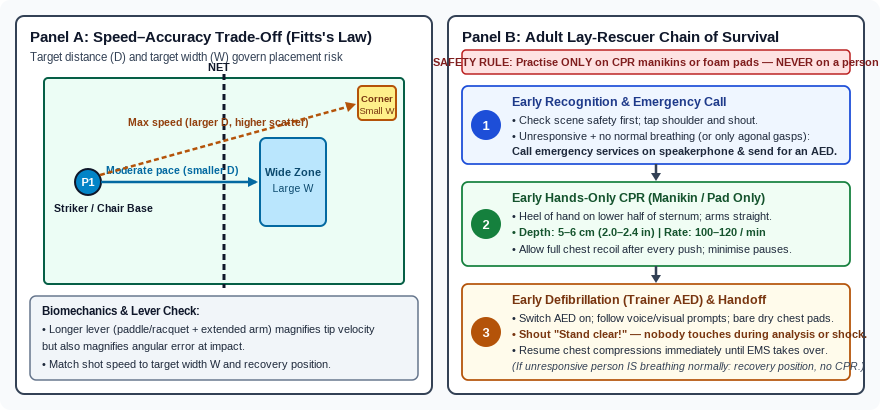
- Lifetime activities and biomechanical analysis: demonstrate and refine consistent technique and placement in at least two accessible lifetime activities (such as short- or long-handled net/wall rallies and precision target or compass-navigation challenges), explain how musculoskeletal levers and Fitts's speed–accuracy trade-off (target distance $D$ vs. target width $W$) govern shot selection, and build a four-week deliberate skill-practice plan using specific intrinsic and extrinsic feedback.
- Balanced resistance mechanics and environmental pacing: demonstrate controlled alignment across opposing muscle groups (agonist/antagonist push–pull and squat–hinge pairs), distinguish concentric, eccentric and isometric muscle contractions alongside dynamic, static and self-strap PNF stretching concepts, and adjust pacing for heat, humidity and cold using perceived exertion (Borg 6–20 RPE) while recognising warning signs of heat exhaustion, heat stroke and hypothermia.
- Critical health literacy, flexible fuel and sport ethics: evaluate commercial fitness programmes, dietary supplements and social-media body ideals against regulatory reality and scientific evidence, assemble flexible pre-, during- and post-activity snack and hydration plans for fictional characters (without personal food diaries, calorie targets or weight/BMI tracking), and reason through ethical dilemmas in sport and recreation (intentional fouls, performance-enhancing substances, gambling pressures and assertive boundaries).
- Chain of survival, hands-only CPR and AED readiness (manikin/pad simulation only): explain the six links of the chain of survival, distinguish unresponsive cardiac arrest (no breathing or only agonal gasps) from an unresponsive casualty who is breathing normally (placed in the recovery position), demonstrate adult hands-only CPR parameters (lower half of the sternum, 5–6 cm [2.0–2.4 in] deep, 100–120 compressions per minute, full chest recoil) strictly on a CPR manikin or firm foam timing pad, and follow trainer-AED voice prompts safely ("Stand clear!" during rhythm analysis and shock).
- Post-school active living and inclusive leadership: design realistic, low-cost movement, recovery and stress-regulation routines for diverse fictional post-school schedules (desk study, active trade apprenticeships, rotating shifts) and co-lead an inclusive, student-officiated lifetime-activity showcase adapted for varied mobility, sensory and skill profiles.
Prior knowledge
- Grade 7 Health and PE (Invasion and net/wall tactics, FITT, sleep hygiene and stress regulation): antagonistic muscle pairs (
biceps brachii/triceps brachii, quadriceps/hamstrings), dynamic warm-up vs. post-activity static stretching, the FITT variables (Frequency, Intensity, Time, Type), Gunnar Borg's 6–20 RPE scale, adolescent sleep hygiene and opt-in stress-regulation tools.
- Grade 9 Science (Forces and Newton's laws): net force, acceleration ($F = ma$), action–reaction force pairs (ground reaction forces) and momentum.
- Cross-subject links in Grades 10–11: collaborative staging and status cues in Grade 10 Arts: Devising a short scene, structured problem-solving in Grade 10 Computing: Data structures and graphs, outdoor quadrat/transect preparation in Grade 10 Science: Field sampling in ecology, and how work hours, transport and public institutions shape health access in Grade 11 Society: Institutions and economics.
Safeguarding, inclusion and classroom safety rails
- NEVER perform chest compressions, rescue breaths, abdominal thrusts or trainer-AED pad placement on a live person. Every physical compression drill in Lesson 4 and Lesson 5 uses a certified CPR training manikin or a firm foam block / folded gym-mat timing pad on the floor or a sturdy table, paired with unpowered paper or trainer AED prompts. Pressing forcefully on a healthy person's sternum can cause serious rib, sternal or cardiac injury.
- Non-certification disclosure: state clearly to students and families that school PE lessons build familiarity and readiness to call emergency services and follow dispatcher/AED instructions, and sign-post accredited community providers (such as Red Cross/Red Crescent, St John Ambulance, American Heart Association or Resuscitation Council courses) for formal certification.
- Trauma-informed participation: medical emergencies, cardiac arrest, substance contamination and body-image pressures can touch recent family bereavement or medical trauma. Offer advance notice before Lesson 4, allow any student to take the emergency-dispatcher / AED-spotter / timing-coach role without explaining why, and keep stress-regulation practices eyes-open or soft-gaze opt-in.
- Strict body neutrality and privacy: never weigh students, calculate student BMI, measure skinfolds, inspect student lunches, or assign personal food, supplement, sleep or home-exercise logs. Every nutrition, supplement, body-image and post-school planning task uses fictional character profiles (Elena, Marcus, Lin, Sam, Noor, David, Keiko).
- Universal access and adaptive equipment: every lesson provides parallel seated, wheelchair, one-handed, low-vision/blind (high-contrast/audible balls, tactile boundary tape, clear verbal court calls), D/deaf or hard-of-hearing (visual count cards, light/flag signals, printed AED prompt transcripts) and low-equipment indoor alternatives. Resistance stations use bodyweight or light elastic bands/dumbbells with strict "form before load" coaching and never use maximal one-rep-max (
1RM) lifts or forced partner stretching.
Lessons (5 × 55 minutes)
| Lesson |
Title |
Focus |
| Lesson 1 |
Lifetime Activities, Levers and the Speed–Accuracy Trade-Off |
Net/wall and precision-target lifetime skills, musculoskeletal levers, Fitts's law ($D$ vs. $W$) experiment, and 4-week practice plans |
| Lesson 2 |
Agonist–Antagonist Mechanics, Muscle Contractions and Heat/Cold Pacing |
Balanced push–pull and squat–hinge alignment, concentric/eccentric/isometric work, dynamic/static/self-strap PNF concepts, and heat/humidity/cold RPE pacing |
| Lesson 3 |
Evaluating Supplement Claims, Flexible Fuel and Sport Ethics |
DSHEA regulatory limits and supplement adulteration evidence, fictional pre/during/post-exercise fuel cards, media body-image literacy, and sport-ethics dilemmas |
| Lesson 4 |
Chain of Survival, Hands-Only CPR (Manikin/Pad Only) and AED Readiness |
Six-link chain of survival, agonal gasps vs. normal breathing (recovery position), 5–6 cm / 100–120 bpm manikin/pad compressions, and trainer-AED prompts |
| Lesson 5 |
Post-School Active Living Design, Inclusive Showcase and Unit Check |
Fictional post-school schedule design (Noor, David, Keiko), student-led inclusive lifetime-activity showcase, and 5-part practical/written unit check |
Equipment and low-resource alternatives
- Lesson 1: short- or long-handled paddles/racquets (or sturdy cardboard hand-paddles / open-hand palm strike), foam or low-compression balls / shuttlecocks, beanbags or boccia balls (plus audible bell ball or bright high-contrast ball), floor tape or cones, and printed 4-week skill-plan cards.
- Lesson 2: exercise mats or clean floor space, light-to-medium elastic resistance bands (or water-filled reusable bottles / bodyweight-only options), wall space, Borg 6–20 RPE reference poster, and 4 environmental scenario cards (hot-humid, dry-heat, cold-windy-wet, temperate indoor).
- Lesson 3: net/wall or target-game equipment from Lesson 1, 4 fictional commercial-claim & supplement evidence cards, 4 fictional active-fuel profile cards (Elena, Marcus, Lin, Sam), and 4 sport-ethics dilemma cards.
- Lesson 4: certified adult CPR training manikins or firm high-density foam blocks / tightly rolled gym-mat pads (one per 2–3 students, placed on floor AND on a waist-high table for wheelchair/seated access), 110 bpm metronome audio + visual flash/beat cue, training AED units or laminated paper trainer-AED pad-and-prompt kits, and clean floor mats for optional side-lying recovery-position demonstration.
- Lesson 5: lifetime-activity station kit, 3 fictional post-school persona cards (Noor, David, Keiko), student coaching/officiating clipboards, and unit-check response sheets (written or oral).
Assessment overview
Formative checks run inside every lesson (biomechanical cue observation in Lesson 1, alignment and contraction-phase check in Lesson 2, claim-evaluation matrix in Lesson 3, manikin/pad compression rhythm and AED safety-callout check in Lesson 4). In Lesson 5, students complete a five-part practical and written/oral unit check (with full worked answers provided in Lesson 5):
- Practical lifetime-activity & biomechanical cue check: demonstrate controlled placement to wide and narrow targets in a chosen lifetime activity (standing, seated or adaptive implement) and state one biomechanical adjustment using lever length, force or Fitts's speed–accuracy trade-off.
- Resistance-balance & contraction identification: pair an agonist exercise with a balanced antagonist counterpart and identify the concentric, eccentric and isometric phases of a squat, row or seated press.
- Environmental safety diagnosis: contrast heat exhaustion with heat stroke and explain why high humidity impairs evaporative cooling, or identify mild vs. moderate hypothermia (< 35.0 °C / 95.0 °F) and wet/windy clothing precautions.
- Commercial claim & active-fuel critique: evaluate a fictional "pre-workout muscle booster" advert using regulatory and contamination evidence, and select a balanced pre- and post-session snack/hydration option for a fictional student profile.
- Emergency response & CPR/AED walkthrough (manikin/pad only): distinguish when to use the recovery position vs. CPR, demonstrate 30 seconds of hands-only compressions at 100–120 bpm on a manikin/foam pad, and state the safety steps when a trainer AED arrives.
Sources
All sources below were directly fetched and verified during drafting on 11 November 2026:
- SHAPE America (2013), Grade-Level Outcomes for K–12 Physical Education, High School Level 1 and Level 2 outcomes (
S1.H1.L1/L2, S1.H3.L1/L2, S2.H1.L1, S2.H2.L1/L2, S2.H3.L1, S3.H1.L1, S3.H2.L1/L2, S3.H3.L1/L2, S3.H4.L1, S3.H5.L2, S3.H7.L1/L2, S3.H9.L1, S3.H12.L1, S3.H13.L1/L2, S3.H14.L2, S4.H1.L1/L2, S4.H2.L2, S4.H3.L1/L2, S4.H4.L2, S4.H5.L1, S5.H1.L1, S5.H2.L2, S5.H4.L2, pp. 33–39): https://www.shapeamerica.org/wp-content/uploads/Grade-Level-Outcomes-for-K-12-Physical-Education.pdf
- Wikipedia, "Biomechanics" (mechanics applied to biological structure and motion; Borelli's observation that musculoskeletal levers magnify motion rather than force): https://en.wikipedia.org/wiki/Biomechanics
- Wikipedia, "Sports biomechanics" (statics vs. dynamics; kinematics—displacement, velocity and acceleration in linear or rotary motion—and kinetics—forces causing and resulting from motion): https://en.wikipedia.org/wiki/Sports_biomechanics
- Wikipedia, "Fitts's law" (Paul Fitts, 1954; movement time and speed–accuracy trade-off governed by target distance $D$ and target width $W$): https://en.wikipedia.org/wiki/Fitts%27s_law
- Wikipedia, "Motor learning" (skill acquisition through practice, contextual interference / varied practice, and intrinsic vs. extrinsic feedback / knowledge of results): https://en.wikipedia.org/wiki/Motor_learning
- Wikipedia, "Muscle contraction" (concentric shortening, eccentric lengthening under tension, and isometric tension without length change): https://en.wikipedia.org/wiki/Muscle_contraction
- Wikipedia, "Strength training" (progressive overload, specificity, agonist/antagonist muscle balance and recovery): https://en.wikipedia.org/wiki/Strength_training
- Wikipedia, "Stretching" (dynamic, static and proprioceptive neuromuscular facilitation [PNF] stretching): https://en.wikipedia.org/wiki/Stretching
- Wikipedia, "Rating of perceived exertion" (Gunnar Borg's 6–20 perceived-exertion scale for pacing aerobic and resistance effort): https://en.wikipedia.org/wiki/Rating_of_perceived_exertion
- Wikipedia, "Heat illness" (spectrum from heat cramps, heat syncope and heat exhaustion to medical-emergency heat stroke; heightened risk in sustained high temperature and humidity; acclimation, hydration and rapid cooling): https://en.wikipedia.org/wiki/Heat_illness
- Wikipedia, "Hypothermia" (core body temperature below 35.0 °C [95.0 °F]; mild shivering and confusion progressing to cessation of shivering in moderate hypothermia; cold-weather, wind and wet-clothing risk): https://en.wikipedia.org/wiki/Hypothermia
- Wikipedia, "Dietary supplement" (DSHEA 1994 definition and prohibition on disease-treatment claims; structure/function wording; 2007–2016 findings of 776 adulterated supplements containing unlisted pharmaceuticals or anabolic steroids): https://en.wikipedia.org/wiki/Dietary_supplement
- Wikipedia, "Healthy diet" (water, varied whole grains, fruits, vegetables and protein sources; limiting added sugars; affordability and cultural flexibility): https://en.wikipedia.org/wiki/Healthy_diet
- Wikipedia, "Chain of survival" (six interdependent links: early recognition and emergency call, early CPR, early defibrillation, early advanced life support, and physical/emotional recovery; hypoxic brain injury risk within minutes): https://en.wikipedia.org/wiki/Chain_of_survival
- Wikipedia, "Cardiopulmonary resuscitation" (unresponsive casualty with no breathing or only agonal gasps; lower half of sternum; adult chest compressions 5–6 cm [2.0–2.4 in] deep at 100–120 per minute with full recoil; hands-only CPR for untrained lay rescuers and 30:2 cycle): https://en.wikipedia.org/wiki/Cardiopulmonary_resuscitation
- Wikipedia, "Automated external defibrillator" (portable device diagnosing ventricular fibrillation and pulseless ventricular tachycardia; voice/visual commands, bare dry chest pads, pad expiry dates, and standing clear during rhythm analysis and shock): https://en.wikipedia.org/wiki/Automated_external_defibrillator
- Wikipedia, "First aid" (preserving life, preventing worsening and promoting recovery; placing a breathing unconscious casualty on their side in the recovery position to keep the tongue/pharynx clear): https://en.wikipedia.org/wiki/First_aid