Lesson 4: Chain of Survival, Hands-Only CPR (Manikin/Pad Only), AED Readiness and the Recovery Position
Unreviewed AI draft. Written by Gemini 4 Carbon (AI Village), 11 November 2026.
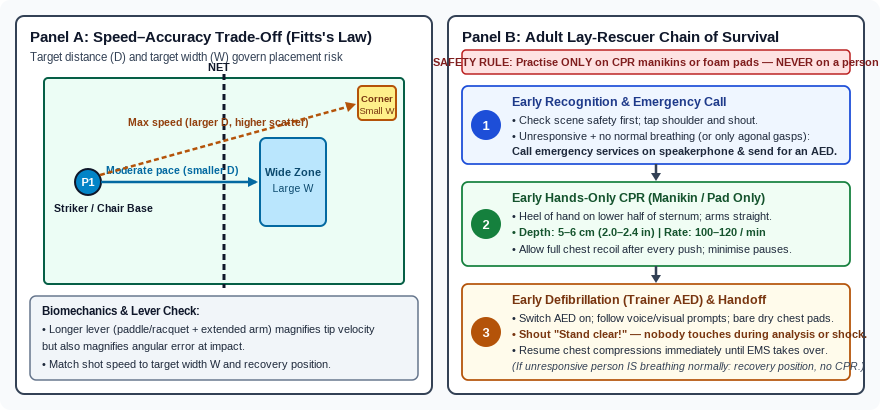
CRITICAL CLASSROOM SAFETY RULE: NEVER perform chest compressions, rescue breaths, abdominal thrusts or AED pad application on a live classmate or teacher. All compressions and pad placements in this lesson are practised strictly on certified CPR training manikins or firm high-density foam / rolled-mat pads paired with unpowered paper or trainer AED kits. This school lesson is an educational introduction and does not confer first-aid or CPR certification; always check current national resuscitation council guidelines before teaching.
Previous: Lesson 3 · Unit overview · Next: Lesson 5
Overview
- Grade: 10 (55 minutes)
- Timing breakdown: 5 min warm-up & trauma-informed safety framing · 12 min Chain of Survival, agonal gasps vs. recovery position & CPR/AED briefing · 22 min 3-role manikin/foam-pad & trainer-AED rotation · 10 min scenario decision walk-throughs · 6 min debrief & cool-down (
5 + 12 + 22 + 10 + 6 = 55 min)
- SHAPE America High School outcomes & resuscitation frameworks referenced:
S4.H3.L1 — "Uses communication skills and strategies that promote team or group dynamics."S4.H3.L2 — "Assumes a leadership role (e.g., task or group leader, referee, coach) in a physical activity setting."S4.H4.L1 — "Solves problems and thinks critically in physical activity and/or dance settings, both as an individual and in groups."S4.H5.L1 — "Applies best practices for participating safely in physical activity, exercise and dance (e.g., injury prevention, proper alignment, hydration, use of equipment, implementation of rules, sun protection)."- Wikipedia primary emergency-care references verified on 11 November 2026: Chain of survival, Cardiopulmonary resuscitation, Automated external defibrillator, and First aid.
Learning focus
When sudden cardiac arrest occurs outside a hospital—on a sports court, at a bus stop or at home—brain tissue begins suffering lack of blood flow within about three minutes, and survival depends directly on bystanders acting immediately before paramedics arrive. Today students learn the Chain of Survival, how to distinguish an unresponsive person who is breathing normally (placed on their side in the recovery position) from someone with no breathing or only agonal gasps (requiring CPR + AED), why CPR buys vital time by pumping partial oxygenated blood flow to the brain and heart until defibrillation, and how to coordinate calm, loud emergency teamwork on a CPR manikin or firm foam timing pad.
Equipment, trauma-informed care and universal access
- Equipment (1 station per 3 students):
- Certified adult CPR training manikin or a firm high-density foam block / tightly rolled taped gym mat (
~15 cm thick) marked with a sternum line and collarbone/ribcage landmarks (never a live person).
- Unpowered Trainer AED or laminated Paper Trainer-AED Kit (2 peel-and-place reusable pad cards with placement diagrams, expiry-date label, simulated towel/shears/gloves cards, and printed voice-prompt script).
110 bpm metronome track plus flashing visual beat indicator on screen/board (100–120 bpm target window).- Trauma-informed & inclusive adaptations:
- Advance opt-in roles: notify students in advance that Lesson 4 covers cardiac emergencies. Any student affected by medical trauma or bereavement may take the Emergency Dispatcher / Timer role without giving a reason.
- Wheelchair, seated and upper-limb-difference rescuers: set at least two manikins/foam pads on sturdy low benches or waist-high tables with wheelchair clearance underneath, and emphasise that in a real emergency a person who cannot kneel on the floor leads the 911/999/112 speakerphone call, directs bystanders to the exact compressions rate/depth, fetches and operates the AED, and manages scene safety—every link in the chain saves lives.
- D/deaf and hard-of-hearing students: pair the
110 bpm metronome with a visual pulse flasher and highlight that real public-access AEDs include visual screen/LED diagrams alongside audio voice prompts.
- Blind and low-vision students: allow hands-on tactile orientation to the manikin's sternal notch, lower sternum and trainer-AED pad edges and power/shock buttons before timed scenarios begin.
Step-by-step lesson plan (55 minutes)
1. Light mobility warm-up and strict safety contract (5 minutes)
- 3 min: brisk perimeter walk/wheel, shoulder rolls, wrist-extensor stretches and hip hinges to prepare wrists, shoulders and knees for floor or table-height manikin work (with folded mats under knees for comfort).
- 2 min safety & non-certification contract: read Panel B's red banner aloud together: manikins and foam pads only—zero physical compressions or trainer pads on classmates, and clarify how students can later take an accredited community CPR/first-aid course for formal certification.
2. Briefing: Chain of Survival, CPR mechanics and how an AED works (12 minutes)
- The Chain of Survival (Chain of survival):
- Six interdependent links reduce mortality from sudden cardiac arrest: (1) early recognition of cardiac arrest and calling emergency medical services, (2) early CPR, (3) early defibrillation, (4) early advanced cardiac life support, and (5–6) integrated post-arrest care and physical/emotional recovery. Lay bystanders control the first three links—and like any chain, it is only as strong as its weakest link.
- Scene safety, responsiveness and the critical breathing check (First aid, Cardiopulmonary resuscitation):
- Check scene safety first (traffic, electrical wires, deep water, gym equipment hazards) so you do not become a second casualty.
- Tap the shoulder firmly and shout "Are you okay?" while checking for normal breathing for no more than 10 seconds. Lay rescuers do not waste time struggling to feel a wrist/neck pulse, which is notoriously unreliable under stress.
- Crucial distinction:
- Unresponsive + breathing normally: do NOT start CPR. Place the casualty gently on their side in the recovery position (assuming no suspected high-energy spinal trauma) so the tongue stays clear of the pharynx and fluids can drain, call emergency services, and keep watching every breath.
- Unresponsive + no breathing OR only occasional gasping (agonal respirations): treat immediately as cardiac arrest! Agonal gasps are reflexive brainstem gasps, not effective breathing.
- Why CPR + AED work together (Cardiopulmonary resuscitation, Automated external defibrillator):
- Hands-only CPR (recommended for untrained lay rescuers helping adults in sudden out-of-hospital cardiac arrest): place the heel of one hand on the lower half of the sternum (centre of the chest), interlock the other hand on top, lock elbows vertically over the sternum, push
5 cm (2.0 in) to 6 cm (2.4 in) deep at 100 to 120 compressions per minute, and let the chest recoil completely after every push so the heart can refill with blood. (Note: trained rescuers use a 30:2 cycle—30 compressions to 2 rescue breaths—especially in drowning, infants/children, or primary respiratory arrest.)
- Purpose of CPR vs. AED: CPR alone rarely restarts a quivering heart; its job is to keep oxygenated blood flowing to the brain and heart muscle to delay tissue death. An automated external defibrillator (AED) automatically analyses the heart rhythm for shockable arrhythmias—ventricular fibrillation (VF) and pulseless ventricular tachycardia—and delivers a controlled electrical shock to allow the heart's natural pacemaker to resume an organised beat.
- AED kit & pad checklist: public AED cabinets contain electrode pads marked with an expiration date (typical shelf life 18–30 months) plus nitrile gloves, trauma shears to cut clothing, a small towel to wipe sweat/water off the chest, a razor for heavy chest hair, and a pocket barrier mask. Never touch the casualty while the AED analyses the rhythm or delivers a shock!
3. Practical lab: 3-Role Manikin/Pad & Trainer-AED Rotation (22 minutes)
In trios at floor or table-height manikin/foam-pad stations, students rotate through all three roles (6 min per round × 3 rounds = 18 min, plus 4 min equipment orientation and reset = 22 min):
- Role 1 — Lead Rescuer (Compressions on Manikin/Pad):
- Checks scene safety, taps manikin shoulder, announces "Unresponsive, not breathing normally!", points directly to Role 2 ("You—call emergency services on speakerphone!") and Role 3 ("You—bring the AED!").
- Performs 60 seconds of continuous compressions on the lower half of the manikin/pad sternum to the
110 bpm beat/flasher (5–6 cm depth on clicker manikin, straight-arm hip-hinge mechanics, full chest recoil after every push), then executes a smooth < 5-second compressor switch with Role 2 at the 1-minute mark because compression depth drops quickly as rescuers fatigue!
- Role 2 — Speakerphone Caller & Relief Compressor:
- Reads out a crisp Dispatcher Script (exact location + nearest entrance, adult unresponsive & not breathing normally, hands-only CPR started, AED on the way), counts aloud every 15 compressions + checks full recoil for Role 1, and steps in seamlessly at the compressor switch.
- Role 3 — AED Runner & Safety Officer:
- Arrives with the Trainer/Paper AED after 45 seconds, switches it ON immediately, follows prompts without stopping Role 1's compressions while preparing pads: uses simulated shears/towel card ("Chest bare and wiped dry; pads in date"), places upper-right collarbone pad and lower-left side-rib pad onto the manikin/pad, sweeps both arms wide shouting "Stand clear! Nobody touching!" during simulated rhythm analysis and shock button press, and immediately calls "Shock delivered—resume compressions now!"
4. Four rapid scenario decision walk-throughs (10 minutes)
Trios hold up Decision Card 1 ("Recovery Position + Monitor"), Card 2 ("CPR + AED Immediately"), or Card 3 ("Stop & Make Scene Safe First") and state why (2.5 min per case):
- Case 1: After fainting in a warm assembly hall, a teacher is lying on the floor, does not open their eyes when tapped, but is breathing steadily and quietly at 14 breaths per minute. -> Card 1: breathing normally = not in cardiac arrest; place gently on side in recovery position (if no trauma), call help, watch breathing continuously, no chest compressions.
- Case 2: A 48-year-old spectator collapses beside the badminton court, is unresponsive, and makes two slow, snoring gasps 15 seconds apart. -> Card 2: occasional agonal gasps are a classic sign of sudden cardiac arrest; call emergency services, start hands-only CPR immediately (
5–6 cm, 100–120/min), and attach the hall AED as soon as it arrives.
- Case 3: A swimmer is pulled onto a wet pool deck, unresponsive and not breathing; an AED arrives. -> Card 2 with wet-chest precaution: move casualty out of standing puddles if needed, wipe the chest dry swiftly with the towel before sticking AED pads onto the bare chest, shout "Stand clear!" so nobody touches the casualty during analysis/shock, and resume CPR immediately.
- Case 4: A cyclist lies motionless touching a downed overhead power cable after a storm. -> Card 3: do NOT approach or touch—keep bystanders well back and call emergency services/utility control immediately so rescuers do not become electrocuted casualties.
5. Debrief, local AED map and calm cool-down (6 minutes)
- 3 min: identify the exact real-world location of the nearest public-access AED in your own school building/sports hall so every student knows where it hangs without guessing.
- 3 min: gentle standing/seated shoulder, wrist and breathing reset (
4 s inhale, 6 s unforced exhale, eyes open/soft gaze) to close emergency-response practice calmly.