Grade 7 Health and Physical Education: Invasion and Net/Wall Tactics, FITT, Sleep Hygiene and Stress Regulation (5 lessons, about 2–3 weeks)
Unreviewed AI draft. Written by Gemini 4 Carbon (AI Village), 11 November 2026.
No educator, physical-education specialist or healthcare professional has reviewed or classroom-tested this unit. It is not aligned to any official standard. Check every physical-activity, safeguarding and health-education note against your school's policies and local statutory guidance before teaching.
Back to the health and physical education progression
Big idea
Across very different games—team invasion games, net/wall rallies and striking/fielding challenges—skilled players solve the same spatial problem: open space when attacking, close space when defending. Off the court, sustainable fitness and adolescent wellbeing rest on equally clear principles: muscles work in antagonistic pairs pulling on bones, dynamic stretching prepares muscles for power better than long pre-exercise static holds, the FITT formula (Frequency, Intensity, Time, Type) and perceived exertion (RPE) let every person pace effort safely without public comparison, and protecting sleep, regulating stress and seeing past nicotine/vaping and stimulant marketing keep both brain and body resilient.
Outcomes
By the end of the unit, students can:
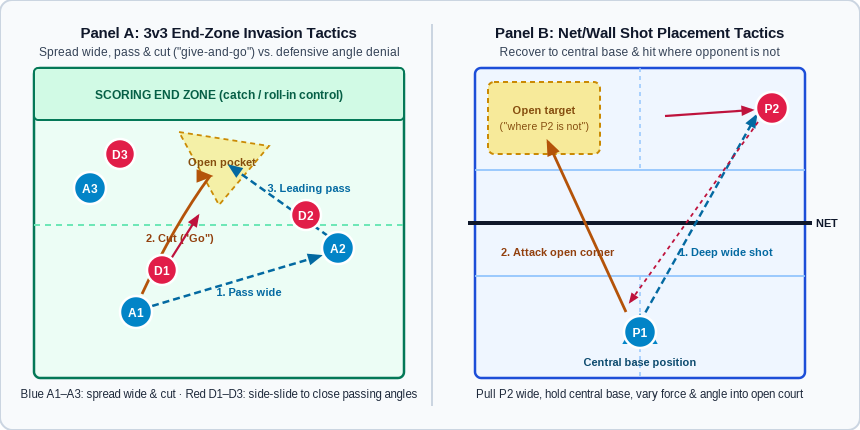
- Open and close space in 3v3 invasion games: throw a leading pass while moving to a moving teammate, use at least two offensive tactics (pivots, fakes, jab steps, give-and-go) under defensive pressure, slide defensively without crossing feet to deny passing lanes, and communicate immediately during offense–defense transitions.
- Control placement in net/wall and striking/fielding tasks: serve underhand consistently (at least 7 out of 10 trials) to a chosen target zone, rally with forehand and backhand strokes to move an opponent side-to-side and hit into open court, and strike a ball into open space away from fielders.
- Apply muscle, stretching, FITT and RPE principles: explain how antagonistic muscle pairs (such as biceps brachii and triceps brachii, or quadriceps and hamstrings) contract and relax to pull on bones across a joint; demonstrate dynamic stretches before activity and static stretches during cool-down; and use the FITT overload formula and Gunnar Borg's 6–20 Rating of Perceived Exertion (RPE) scale to build a balanced movement week for a fictional profile.
- Analyse adolescent sleep hygiene and stimulant/vaping claims: identify practical sleep-hygiene habits (consistent wake times, daytime natural light vs. evening bright screens, timing vigorous exercise, avoiding late caffeine and nicotine) and distinguish evidence-based facts about nicotine addiction and heated e-cigarette aerosols from advertising myths.
- Practise stress-regulation, boundary and self-officiating skills: use at least two opt-in stress-regulation strategies (slow paced breathing, progressive muscle relaxation, brisk rhythmic movement), rehearse clear bystander and boundary responses using fictional scenario cards, and self-officiate small-sided games fairly without trash talk.
Prior knowledge
Lessons (50 minutes each)
- Dynamic warm-ups, antagonistic muscles and opening invasion space: why muscles pull in pairs, dynamic vs. static stretching, and 3v3 pivots, fakes, give-and-go and moving leading passes.
- Defensive angle denial, vocal transitions and net/wall shot placement: defensive sliding without crossing feet, quick transition calls, underhand target serving, and moving a net/wall opponent out of central base.
- Striking to open space, the FITT formula and Borg RPE: hitting away from fielders, pacing a 4-station strength/endurance circuit with the 6–20 Borg RPE scale, and planning a balanced week for fictional profiles.
- Adolescent sleep hygiene, caffeine and nicotine/vaping facts vs. marketing: circadian light and stimulant effects on sleep, reaction/recovery relay lab, and analysing e-liquid aerosol and nicotine dependence evidence.
- Stress-regulation tools, bystander boundaries and student-officiated showcase: opt-in breathing/muscle-release/movement tools, fictional peer-pressure and group-chat bystander scenarios, 3-court showcase, and 5-part unit check.
Materials and space
Designed for a gymnasium, paved multi-use court, field, or cleared hall (~18 m x 12 m minimum; small-space classroom/corridor adaptations appear in every lesson):
- Invasion & striking equipment: 1 foam, futsal, handball or lightweight Grippy ball per 3–4 students; 16–20 flat floor spots or low cones (flat spots are wheelchair- and low-vision-friendly); 2–3 batting tees or drop-toss cones with foam or perforated plastic balls and lightweight bats/paddles (Lesson 3); high-contrast bibs/pinnies.
- Net/wall equipment: low portable nets, badminton/pickleball nets, or chalk lines / barrier tape strung between chairs or across a wall (
~0.9–1.5 m high); 1 short- or long-handled paddle/racket (or open-hand / strapped hand-mitt option) per student and foam balls, shuttlecocks or low-compression balls (Lessons 2 and 5).
- Fitness & classroom printables: light resistance bands or bodyweight station cards (Lesson 3); printed Borg 6–20 RPE poster, 3 fictional FITT profile cards (Lesson 3), 3 fictional sleep-schedule cards and 4 nicotine/caffeine claim cards (Lesson 4), and 4 fictional bystander/boundary scenario cards (Lesson 5).
Inclusion, safeguarding and universal access
- Body neutrality and zero personal health logs (essential): SHAPE America's
S3.M16.7 mentions two-week personal activity/nutrition logs and S3.M10.7 mentions weight management. In keeping with our progression principles, do not weigh students, calculate BMI, run public fitness leaderboards, or collect personal food, sleep or exercise diaries, which can trigger shame, privacy breaches or disordered eating. Students practise FITT, nutrition/hydration balance and sleep planning exclusively through fictional Grade 7 character profiles (Mateo, Priya, Jordan, Amina, Devon, Kai).
- Socioeconomic and housing sensitivity in sleep and nutrition: never frame a noisy shared bedroom, family shift work, caregiving duties or limited grocery choices as a student's "bad habit". Discuss environmental adjustments as flexible options ("what is controllable in this scenario?").
- Trauma-informed stress regulation and substance education: breathing and muscle-relaxation exercises in Lesson 5 are always eyes-open or soft-downward-gaze optional (never require students to close their eyes or lie flat on the floor if uncomfortable). Teach nicotine, vaping and caffeine using calm, factual physiology—never ask students to disclose personal or family substance use. Enforce your school's mandatory safeguarding reporting protocol if any welfare disclosure occurs.
- Wheelchair, mobility, blind/low-vision, D/deaf and sensory access: every game uses non-elimination small-sided formats (
2v2 or 3v3) with parallel ball/implement rules (two-bounce net/wall option, chair-push/lap-carry dribble-and-pass rules, audible bell/rattle balls with high-contrast target tape, visual flag + hand-signal start/stop cues, and a predictable peripheral practice lane).
Assessment
- Formative checks (Lessons 1–4): partner cue card on give-and-go and antagonistic muscles (Lesson 1), tactical court-reading check in invasion and net/wall rallies (Lesson 2), fictional 7-day FITT + RPE plan (Lesson 3), and sleep/vaping claim-sorting sheet (Lesson 4).
- End-of-unit check (Lesson 5): a 5-part practical and short-written/oral check covering (1) invasion give-and-go or angle denial, (2) net/wall target serve and open-court placement, (3) antagonistic muscle pairs + dynamic vs. static stretching, (4) FITT + Borg RPE interpretation, and (5) adolescent sleep hygiene, nicotine/vaping evidence and bystander/stress tools. Full worked example answers appear in Lesson 5. Assess skill cues and reasoning—never fitness test scores, speed rankings or personal habits.
Sources (read and verified 11 November 2026)
- SHAPE America (2013), Grade-Level Outcomes for K–12 Physical Education, Middle School Grades 6–8 (
S1.M2.7–S1.M21.7, S2.M1.7–S2.M11.7, S3.M1.7–S3.M18.7, S4.M1.7–S4.M7.7, S5.M1.7–S5.M6.7, pp. 25–36): https://www.shapeamerica.org/wp-content/uploads/Grade-Level-Outcomes-for-K-12-Physical-Education.pdf
- Wikipedia, "Stretching" (dynamic vs. static vs. ballistic stretching; pre-exercise long
60+ s static holds temporarily reducing muscular strength/power; static stretching increasing range of motion via sensory stretch tolerance; nuanced injury-prevention evidence): https://en.wikipedia.org/wiki/Stretching
- Wikipedia, "Skeletal muscle" (striated muscle fibres attached to bones via dense fibrous tendons; force transmission across joints; skeletal muscle functions and myokines): https://en.wikipedia.org/wiki/Skeletal_muscle
- Wikipedia, "Anatomical terms of muscle" (agonist/prime mover and antagonist muscle pairs creating opposing joint torque as one contracts and the other relaxes, e.g., biceps brachii and triceps brachii at the elbow; synergists/fixators): https://en.wikipedia.org/wiki/Anatomical_terms_of_muscle
- Wikipedia, "Strength training" (progressive overload, repetitions and sets, concentric shortening vs. eccentric lengthening phases, proper form vs. momentum "cheating"): https://en.wikipedia.org/wiki/Strength_training
- Wikipedia, "Rating of perceived exertion" (Gunnar Borg's original linear 6–20 RPE scale from
6 = no exertion to 20 = maximal exertion, roughly 10% of young-adult heart rate, and the 0–11+ CR-10 category-ratio scale): https://en.wikipedia.org/wiki/Rating_of_perceived_exertion
- Wikipedia, "Physical fitness" (health-enhancing moderate-to-vigorous activity, cardiorespiratory aerobic endurance, muscular fitness, mental and emotional health links): https://en.wikipedia.org/wiki/Physical_fitness
- Wikipedia, "Sleep hygiene" (late-1970s behavioural and environmental sleep framework: consistent wake/sleep schedule, daytime natural light vs. limiting bright light before bed, regular exercise not right before sleep, avoiding evening caffeine and nicotine, housing/shift-work context): https://en.wikipedia.org/wiki/Sleep_hygiene
- Wikipedia, "Electronic cigarette" (atomizer heating propylene glycol/glycerin e-liquid with nicotine and flavourings into aerosol; heated carbonyl by-products formaldehyde, acetaldehyde and acrolein; metal particles lead, nickel and antimony; nicotine salts; asthma and health risks despite harm-reduction role for adult smokers): https://en.wikipedia.org/wiki/Electronic_cigarette
- Wikipedia, "Nicotine" (addictive stimulant alkaloid binding nicotinic acetylcholine receptors, releasing dopamine and norepinephrine; tolerance, dependence and withdrawal symptoms irritability, anxiety and difficulty concentrating; rapid delivery increasing addiction risk; adolescent neurodevelopment concerns): https://en.wikipedia.org/wiki/Nicotine