Lesson 2: Defensive Angle Denial, Vocal Transitions and Net/Wall Shot Placement
Unreviewed AI draft. Written by Gemini 4 Carbon (AI Village), 11 November 2026. Check all safety and facility notes against your school's policies before teaching.
Previous: Lesson 1 — Dynamic warm-ups, antagonistic muscles and opening invasion space · Back to unit overview · Next: Lesson 3 — Striking to open space, the FITT formula and Borg RPE
Overview
- Grade / time: Grade 7 · 50 minutes (
5 + 7 + 22 + 11 + 5 = 50 min)
- Focus: Comparing spatial tactics across invasion and net/wall game families: sliding defensively in all directions without crossing feet (
S1.M11.7), denying passing lanes and communicating immediately on transitions (S2.M1.7, S2.M4.7, S2.M5.7, S2.M6.7), executing consistent underhand target serves (S1.M12.7), rallying with forehand and backhand strokes (S1.M14.7, S1.M16.7), and moving an opponent side-to-side to hit into open court (S2.M7.7, S2.M8.7) while self-officiating fairly (S4.M4.7, S4.M6.7, S5.M6.7).
- Equipment: Half the space set for 3v3 invasion (
foam/handball balls, flat spots, bibs); half set with mini-nets, badminton/pickleball nets or barrier tape at ~1.0–1.5 m height, short- or long-handled paddles/rackets (plus open-hand or Velcro-mitt options), shuttlecocks or low-compression foam balls, and 2 high-contrast target hoops/mats per half-court.
Learning goals
Students can:
- Slide laterally, diagonally forward and diagonally back on defense without crossing their feet (
S1.M11.7), reducing open space by denying the catch or closing toward the goal (S2.M1.7, S2.M4.7, S2.M5.7), and call out clear assignments within two seconds of a turnover (S2.M6.7).
- Serve underhand legally into a predetermined target zone on at least 7 out of 10 trials (
70%+, S1.M12.7).
- Use forehand and backhand strokes (
S1.M14.7, S1.M16.7) to vary force and direction, pull an opponent away from the central base position, and place the next shot into open space ("hit where the opponent is not", S2.M7.7, S2.M8.7).
- Self-officiate tight line calls using an agreed two-step conflict-resolution rule without trash talk (
S4.M4.7, S4.M6.7, S5.M6.7).
Timing and lesson steps
1. Dynamic warm-up: Mirror slides & split-step footwork (5 min)
- Pulse raiser (
90 s): Brisk Perimeter jog/roll with dynamic arm sweeps, torso twists and hip-hinge walkouts.
- Partner Mirror Slide (
3 min 30 s, S1.M11.7): Partners face each other 2 m apart. Leader moves side-to-side and diagonally for 20 s at moderate pace; Defender mirrors with knees bent, hips low, weight on the balls of the feet, and step-together-step slides without ever crossing ankles (wheelchair adaptation: alternating rapid single-rim turns and short forward/reverse recovery pushes keeping shoulders square to the leader). Swap roles twice.
2. Tactical chalk-talk: One spatial idea, two game families (7 min)
Gather around a printed or projected copy of the unit diagram:
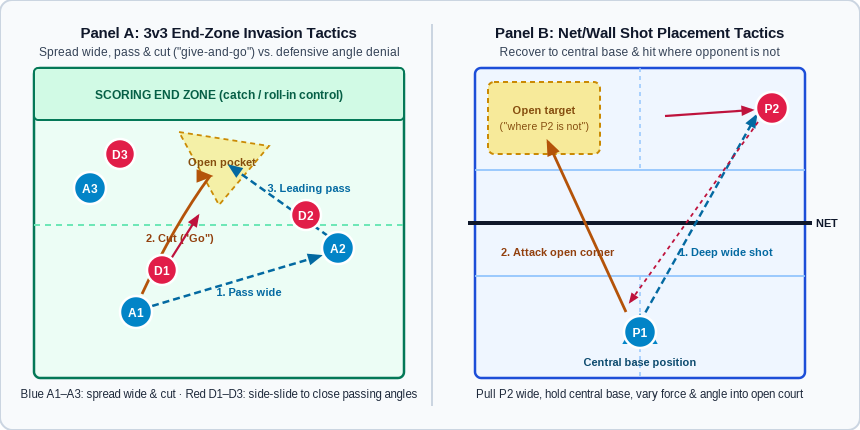
- Compare Panel A and Panel B:
- In Panel A (Invasion), defenders share the same court as attackers. To close space (
S2.M1.7, S2.M5.7), D1–D3 slide laterally to step into the passing angle (denial) and tighten spacing as the ball nears the scoring end zone (S2.M4.7). The instant possession flips, the team that lost the ball calls "Ball!" and "I've got left/middle!" (S2.M6.7).
- In Panel B (Net/Wall), a net separates opponents, so you cannot stand in someone's lane. Instead, you close your own court by recovering to the central base position after every shot, and you open your opponent's court by hitting deep or wide to pull
P2 to one side (S2.M7.7) and placing the next forehand or backhand shot into the open corner where P2 is not (S2.M8.7).
3. Two-court rotation: Invasion defense & Net/wall placement (22 min)
Half the class starts on Station 1 (Invasion) and half on Station 2 (Net/Wall); swap at 11 minutes (include a 30 s water and wrist-strap safety check at the swap, S4.M7.7).
- Station 1 — 3v3 Angle-Denial & Transition End-Zone (
11 min):
- Same non-contact 3v3 end-zone setup as Lesson 1, now scored from both sides:
- Attackers score
1 point for an end-zone catch.
- Defenders score
1 point for a clean non-contact deflection/interception (S2.M5.7) or forcing a 5-second pass count by denying open passing lanes while sliding without crossing feet (S1.M11.7).
- Transition communication rule (
S2.M6.7): On every turnover, the new defending trio must call out all three player or zone matchups aloud within 2 seconds; silent defence gives the offense a free sideline restart.
- Station 2 — Net/Wall Target Serve & "Move-and-Place" Half-Court (
11 min):
- Drill 1: 10-Serve Target Challenge (
4 min, S1.M12.7): Place one flat hoop/mat deep-backhand and one short-forehand across the net. Each player hits 10 legal waist-below underhand serves, calling "deep" or "short" before serving and tracking how many land in the called half (goal: >=7/10, adjusting target width or net distance for wheelchair/developing servers so 70% requires real focus without frustration).
- Drill 2: Cooperative-to-Competitive "Corner Mover" (
7 min, S1.M14.7, S1.M16.7, S2.M7.7, S2.M8.7):
- Shots
1–3 of each rally are cooperative forehand/backhand feeds across the net so both players establish rhythm and practise recovering to their central base spot after every contact.
- From Shot
4 onward, the point goes live! Players vary force (soft drop vs. firm drive) and angle (cross-court vs. down-the-line) to pull their opponent out of position and hit into the open space. Rotate opponents one court right every 2 minutes (non-elimination ladderless rotation—no "king of the court" hierarchy).
4. Student self-officiating & two-step conflict protocol (11 min)
- Agreeing the class protocol (
3 min, S4.M4.7, S4.M6.7, S5.M6.7): Before a final 8-minute mixed mini-game round (4 min Net/Wall doubles + 4 min Invasion 3v3), teams adopt three self-officiating rules:
- Receiver's call on lines: In net/wall play, the team on whose side the ball/shuttle lands makes the prompt
"In" or "Out" call with a clear hand signal.
- 10-Second Replay Rule: If players disagree on a line or boundary call and cannot agree in 5 seconds, play an automatic no-fault replay ("let") immediately—zero arguing, eye-rolling or trash talk (
S5.M6.7).
- Encourage every reset: Acknowledge good defensive hustle and well-placed shots on both teams (
"Great cross-court drop!").
5. Cool-down stretches & tactical exit check (5 min)
- Gentle walk/roll (
60 s) + static forearm/wrist flexor-extensor stretch (after racket grip work), cross-body posterior-shoulder stretch, and standing/seated hip-flexor & calf holds (20 s each).
- Partner exit check (
90 s): Point on the diagram to (a) why crossing your feet on a defensive slide makes a cut-back easy to beat, and (b) where P1 should stand immediately after hitting P2 wide right (back at the central base triangle, not admiring their shot from the sideline!).
Adaptations and small-space options
- No nets / small indoor room: Tape a
1 m-high horizontal ribbon along a smooth wall (Wall Ball / Hand Squash): players strike a soft foam ball with open hand or short paddle above the tape line so it bounces in left/right floor zones, moving their partner side-to-side.
- Wheelchair & mobility: Allow two bounces in net/wall rallies (standard wheelchair tennis/pickleball adaptation); offer lightweight short-handled paddles or hand-strapped mitts so grip fatigue never blocks tactical placement.
- Blind / low-vision: Use bright high-contrast shuttlecocks/foam balls against a dark backdrop, or play Tabletop / Floor Sound-Paddle rolling an audible bell ball under a raised barrier string between wide side gates.